

UAE multinationals face new tax rules. Learn how Global Minimum Tax affects your compliance strategy and cross border operations. Expert guidance inside.
Table of Contents
Impact of Global Minimum Tax on UAE-Based Multinationals: A New Era for Business in the Emirates
Last month, I sat across from a CFO of a Dubai-based multinational—a company that had proudly operated out of a free zone for over a decade. Over coffee, she asked me a question that I’m hearing more and more: “We came here for the 0% tax regime. Do we still belong here?”
Her anxiety was palpable. And honestly, it’s justified. For years, the UAE’s value proposition was simple: set up in a free zone, enjoy zero corporate tax, and watch your business grow. But in 2026, that narrative has fundamentally shifted.
The impact of global minimum tax on UAE-based multinationals is no longer a distant theoretical discussion—it’s a lived reality. From January 1, 2025, the UAE began implementing its Domestic Minimum Top-Up Tax (DMTT) under the OECD’s Pillar Two framework . If your multinational group has consolidated global revenues exceeding €750 million, you’re now looking at a minimum 15% effective tax rate in the UAE.
But here’s what I told that CFO—and what I want to share with you: this isn’t the end of the UAE story. It’s the beginning of a new chapter.
What Exactly Is the Global Minimum Tax?
Before diving into implications, let’s get clear on what we’re dealing with.
The global minimum tax—officially known as Pillar Two—is an OECD-led initiative designed to end the “race to the bottom” in corporate taxation. The premise is straightforward: large multinational enterprises (MNEs) should pay a minimum effective tax rate of 15% in every jurisdiction where they operate, regardless of local incentives .
Who Does It Apply To?
| Criteria | Details |
|---|---|
| Revenue Threshold | Consolidated global revenue ≥ €750 million in at least two of the last four fiscal years |
| Entity Scope | All UAE constituent entities of in-scope MNE groups—including free zone companies |
| Effective Date | Fiscal years starting on or after January 1, 2025 |
The UAE has implemented this through Cabinet Decision No. 142 of 2024, which introduces the Domestic Minimum Top-Up Tax (DMTT) . The genius of the DMTT? It ensures that the UAE—not some other country—collects any top-up tax due on profits earned here.
Source: UAE Ministry of Finance / Kreston Menon analysis
The Personal Story Behind the Policy Shift
I’ve been advising businesses in the UAE since before corporate tax was even a conversation. I remember helping a logistics company structure its regional hub in JAFZA back in 2018. The founder, a British expat named Sarah, had chosen Dubai precisely because of the tax environment.
When I called her about the DMTT last year, she was quiet for a long moment. Then she said: “So we’re just like everywhere else now?”
Here’s what I explained to Sarah—and what I want you to understand: The UAE isn’t becoming “like everywhere else.” It’s becoming more sophisticated.
Think about it. The country introduced a 9% corporate tax in 2023. Now it’s implementing a 15% minimum for large multinationals. This isn’t about losing competitiveness—it’s about gaining credibility. The UAE is signaling to the world: We play by global rules. We’re a mature, stable jurisdiction for long-term investment.
And the numbers back this up. The UAE’s non-oil foreign trade reached a record AED 3.5 trillion in 2024. The country isn’t losing its appeal—it’s evolving .
How the 15% Rule Actually Works
Let me break this down in plain language.
The Blended Rate Reality
Imagine your multinational has two entities in the UAE:
- A mainland entity with 9% corporate tax on AED 40 million profit
- A free zone entity with 0% corporate tax on AED 60 million profit
Total profit: AED 100 million
Total tax paid: AED 3.6 million
Effective tax rate: 3.6%
Under Pillar Two, that 3.6% is well below the 15% threshold. So a top-up tax applies—roughly AED 11.4 million—to bring the effective rate to 15% .
The Calculation Flowchart
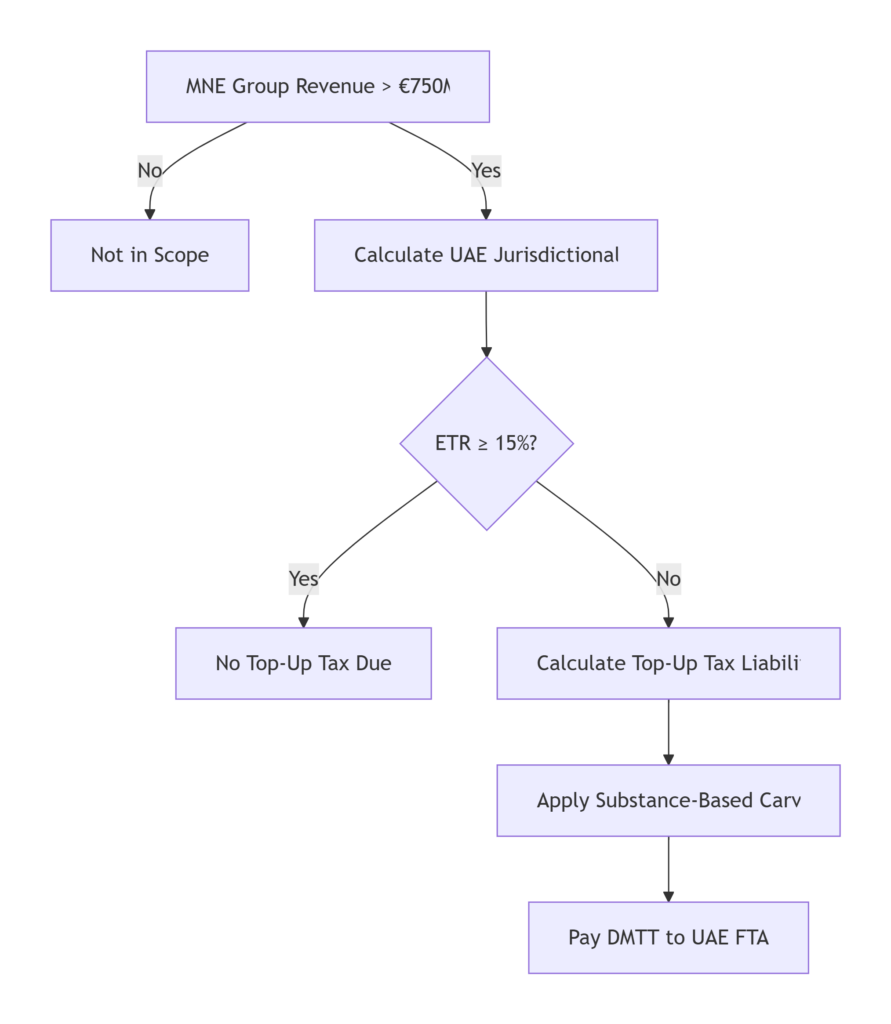
This isn’t about eliminating free zones—it’s about ensuring fairness across jurisdictions. The UAE still offers 0% corporate tax to qualifying free zone persons (QFZPs). The difference now is that for large multinationals, that 0% rate triggers a top-up to 15% .
The Free Zone Question: What Still Works?
This is the question everyone’s asking. And I’ll be honest with you—it’s nuanced.
What’s Changed
For in-scope multinationals, the days of achieving a 0% effective tax rate through free zone structures are over. The DMTT ensures that if your group meets the €750 million threshold, your UAE operations will effectively pay 15%—whether you’re in a free zone or on the mainland.
What Still Matters
But here’s what I told Sarah (the logistics founder), and what I’m seeing play out across the market:
Free zones still offer immense value—just not primarily through tax.
Consider the Dubai International Financial Centre (DIFC). Its value proposition has always been about:
- World-class common law framework
- Independent regulator with international standards
- Deep talent pool and ecosystem
- No currency restrictions
- 100% foreign ownership
Or look at Jebel Ali Free Zone (JAFZA):
- Strategic port access
- Customs duty exemptions on imports/exports
- Simplified logistics infrastructure
- Industry clustering benefits
These advantages don’t disappear because of Pillar Two. In fact, for multinationals that must now pay 15% anyway, these operational and regulatory benefits become more important, not less.
Quick Comparison: Free Zone vs. Mainland Post-Pillar Two
| Factor | Free Zone (QFZP) | Mainland |
|---|---|---|
| Corporate Tax Rate | 0% on qualifying income | 9% |
| Post-DMTT Effective Rate | 15% (with top-up) | 15% (with top-up) |
| Operational Advantages | Zone-specific benefits, customs, ecosystem | Direct market access, no geographic restrictions |
| Best For | Specific activities aligned with zone purpose | Broader commercial activities |
The Data Challenge No One Is Talking About
I want to share something I’ve learned from working with clients through this transition. The biggest challenge isn’t the tax itself—it’s the data.
One of my clients, a technology firm with operations across six countries, recently completed their Pillar Two readiness assessment. Their finance team spent three months just mapping data sources across their ERP systems. Why? Because the GloBE Information Return requires over 240 data points per entity .
Key Data Requirements
- Covered Taxes: Corporate tax paid, withholding taxes, DMTT calculations
- GloBE Income: Financial accounting income with specific adjustments
- Substance-Based Exclusion: Payroll and tangible asset calculations
- Deferred Tax: Tracking temporary differences across jurisdictions
The finance director told me: “We thought we had good systems. We didn’t realize how fragmented our tax data was until we started this process.”
This is a common story. The impact of global minimum tax on UAE-based multinationals is fundamentally about transparency and data integrity. If your systems can’t produce accurate, timely, and auditable tax data, you’re at risk—not just of penalties, but of strategic missteps.
Strategic Moves Smart Companies Are Making
I’m seeing three distinct strategies emerge among multinationals in the UAE.
Optimizing Within the 15% Floor
Rather than trying to beat the system, sophisticated groups are aiming to pay their 15% in the UAE under the DMTT—not elsewhere under the Income Inclusion Rule (IIR) . Why? Because the UAE’s qualified domestic regime ensures the tax stays here, where the business operates.
Building Substance First
The Pillar Two rules include a substance-based income exclusion (SBIE) that carves out a percentage of payroll and tangible assets from the top-up calculation . For groups with meaningful operations in the UAE—real people, real offices, real assets—this reduces the top-up liability.
One of my clients is actually increasing their UAE headcount specifically for this reason. The CFO explained: *“If we’re going to pay 15% either way, we might as well build real capability here. It reduces our top-up and strengthens our operations.”*
Rethinking Intellectual Property and Financing
Historically, many multinationals parked IP in the UAE to benefit from the 0% regime. Under Pillar Two, that strategy needs reevaluation . The question now is: does holding IP in the UAE still make sense if the effective rate is 15%? Often, the answer depends on alternative jurisdictions—if the alternative is 25% elsewhere, the UAE still wins.
Comparison of Strategic Approaches
| Strategy | Description | Best For |
|---|---|---|
| Optimize Within 15% | Accept the floor, ensure DMTT is paid in UAE | Groups with established UAE operations |
| Build Substance | Increase payroll/tangible assets to maximize SBIE | Groups with operational flexibility |
| Restructure Operations | Redistribute profits across jurisdictions with ETRs above 15% | Groups with multiple jurisdictional options |
| Leverage Incentives | Utilize R&D or high-value employment credits | Innovation-focused businesses |
The R&D Incentive: A Glimpse of the Future
Here’s something that gives me genuine optimism. The UAE Ministry of Finance is working on a refundable R&D tax credit expected to range between 30-50% of qualifying expenditure .
Why does this matter under Pillar Two? Because properly structured, these credits can be treated as Qualified Refundable Tax Credits (QRTCs) or even Qualifying Tax Incentives (QTIs) —which can actually improve your GloBE effective tax rate calculation .
This is where the UAE’s strategy becomes clear. The country isn’t abandoning tax competitiveness—it’s pivoting. Instead of competing on zero rates (which Pillar Two neutralizes), it’s competing on smart incentives that reward actual economic activity: R&D, high-value employment, and innovation.
A high-value employment credit is also under consideration, targeting C-suite executives and senior personnel performing core business functions . For multinationals building regional headquarters in the UAE, this could be significant.
Practical Steps for Your Business
If you’re leading a multinational group affected by these changes, here’s your action plan:
Immediate (Next 30 Days)
- Confirm scope: Verify whether your group meets the €750 million revenue threshold
- Map your UAE entities: Identify all constituent entities, including free zone companies
- Data inventory: Assess what data you have and what gaps exist
Short-Term (3-6 Months)
- Calculate jurisdictional ETR: Use GloBE methodology to determine your current effective rate
- Model top-up exposure: Run scenarios with substance-based carve-outs
- Review free zone structures: Ensure QFZP status and substance requirements are met
- Systems upgrade: Implement ERP enhancements for GloBE data collection
Long-Term (6-12 Months)
- Register for DMTT: When the FTA opens registration, be ready
- Transfer pricing alignment: Ensure intercompany transactions reflect arm’s length value
- Incentive planning: Prepare for R&D and high-value employment credits
- Dry run filings: Test your processes before deadlines
The Bottom Line: Opportunity Amid Change
The impact of global minimum tax on UAE-based multinationals is real. It’s significant. It’s reshaping how companies structure, operate, and plan their tax affairs.
But let me share something that gives me confidence. When I spoke with Sarah—the logistics founder I mentioned earlier—she had already started making changes. She’s expanding her team, investing in automation, and building real operational substance in the UAE. When I asked her why she wasn’t considering moving elsewhere, she said:
“I’ve looked at alternatives. Europe’s rates are higher, Asia’s more complicated, and everywhere else has less infrastructure. The UAE is still the best place to do business—I just need to do it differently now.”
That’s the truth of it. The UAE isn’t losing its competitive edge—it’s maturing. And for businesses willing to evolve with it, the opportunities remain substantial.
The companies that succeed will be those that view this not as a compliance burden, but as an invitation to build more resilient, transparent, and strategically sophisticated operations.
How Crossfoot Can Help
Navigating the complexities of UAE tax compliance—from DMTT calculations to strategic structuring—requires more than just technical knowledge. It requires a partner who understands both the numbers and the story behind them.
At Crossfoot, we help multinationals transform tax complexity into strategic advantage. Our services include:
- DMTT Readiness Assessments: Evaluate your exposure and prepare for compliance
- Effective Tax Rate Modeling: Run scenarios to optimize your jurisdictional ETR
- Free Zone Structuring Review: Ensure your structure aligns with both corporate tax and Pillar Two requirements
- Incentive Planning: Position your business for R&D and high-value employment credits
- Integrated Tax and Accounting Solutions: Build the systems and processes you need for accurate, auditable tax data
Contact our expert team today for a free consultation and DMTT readiness assessment. Let’s turn this tax transformation into your competitive advantage.