

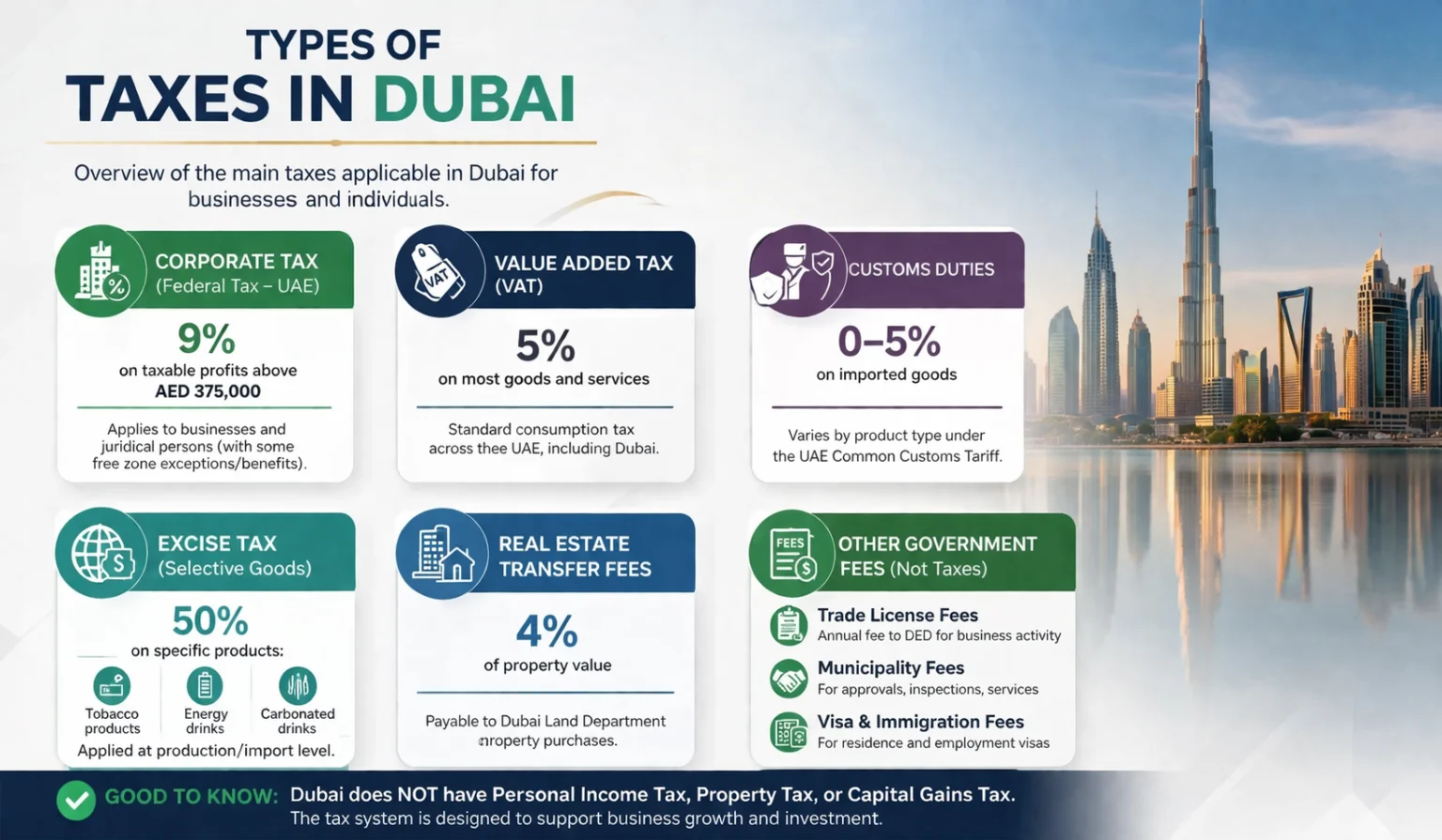
Explore types of taxes in Dubai, including Corporate Tax, VAT, and more. A complete guide for businesses to stay compliant in the UAE.
Table of Contents
Beyond the Myth: Understanding the Real Types of Taxes in Dubai
When I first moved to Dubai, I believed what most people told me: “It’s completely tax-free—you keep everything you earn.”
Like many, I pictured a financial utopia where money flowed in without a single dirham leaving for the government. And in some ways, that dream holds true. There’s no personal income tax on my salary. No capital gains tax on my investments. No inheritance tax to worry about.
But then I started my own business.
Suddenly, I encountered a different reality—a structured, transparent tax system that, while still incredibly favorable compared to London, New York, or Mumbai, demanded my attention and compliance. The types of taxes in Dubai are fewer and lower than almost anywhere else, but they absolutely exist.
Let me walk you through what I’ve learned—not from a textbook, but from navigating this system firsthand.
The Personal Income Tax Myth: What’s Really “Tax-Free”
Here’s what nobody told me before I arrived: your salary is genuinely tax-free.
The UAE government portal confirms this clearly: there is no personal income tax on employment income . When you negotiate a salary of AED 20,000 per month, you receive AED 20,000. No deductions. No annual filing. No surprises.
This single fact drives Dubai’s expatriate boom. According to the Ministry of Economy, this policy has attracted talent from over 190 nationalities, creating one of the most diverse workforces on the planet .
But here’s the nuance: if you’re a freelancer or business owner, you’re not an “employee” in the tax sense. You’re a “taxable person.” And that changes everything.
The Corporate Tax Shift: What Changed in 2023
For decades, Dubai’s business appeal rested on zero corporate tax. That changed in June 2023 with Federal Decree Law No. 47 of 2022—and I felt the shift firsthand when filing my first corporate return.
How Corporate Tax Actually Works
The system is refreshingly simple compared to Western tax codes :
| Taxable Income (AED) | Corporate Tax Rate |
|---|---|
| Up to 375,000 | 0% |
| Above 375,000 | 9% |
| Large multinationals (€750M+ global revenue) | 15% (Pillar Two) |
This tiered structure surprised me. The first AED 375,000 of profit—roughly $102,000—faces zero tax. It’s designed to protect small businesses and startups while asking larger, profitable companies to contribute.
What this means for you: If your business earns AED 500,000 in profit, you pay 9% only on AED 125,000 (the amount above the threshold). Your effective tax rate ends up around 2.25%.
The Free Zone Advantage: Where 0% Still Lives
I registered my company in a free zone, and that decision continues to pay dividends—literally.
Qualifying Free Zone Persons (QFZPs) can still access 0% corporate tax . But there’s a catch that many business owners miss: the 0% rate applies only to “qualifying income”—meaning income from transactions with:
- Foreign clients
- Other free zone companies
- Mainland businesses (with restrictions)
If your free zone company sells directly to the Dubai mainland without proper structuring, that portion of income faces the standard 9% rate .
I learned this from an accountant after nearly making an expensive mistake. Now, I maintain clear separation between my free zone operations and mainland activities.
VAT: The Tax You Encounter Every Day
If corporate tax is the quiet one, VAT is the loud neighbor you can’t ignore.
Introduced in 2018 at 5%, VAT applies to most goods and services . Every time I buy coffee, shop at Carrefour, or pay a consultant, there it is—5% added at checkout.
Who Must Register for VAT
The Federal Tax Authority (FTA) sets clear thresholds :
- Mandatory registration: If taxable supplies exceed AED 375,000 annually
- Voluntary registration: If taxable supplies exceed AED 187,500 annually
Deadlines matter. The FTA requires registration within 30 days of meeting the threshold, with late registration penalties starting at AED 10,000 .
What VAT Looks Like in Practice
Here’s something I didn’t understand until my first VAT return: VAT is a “pass-through” tax. You collect it from customers, then pay it to the government—but you also reclaim VAT you paid on business expenses.
The system tracks:
- Output VAT: 5% you charge on sales
- Input VAT: 5% you pay on purchases
- Net payable: Output VAT minus Input VAT
For service-based businesses like mine, this creates a predictable quarterly obligation. For product-based businesses, cash flow timing becomes critical.
The VAT Certificate: Your License to Charge
If you register, the FTA issues a VAT registration certificate with your Tax Registration Number (TRN) . Without this certificate:
- You cannot legally charge VAT to customers
- You cannot reclaim VAT on expenses
- You cannot issue valid tax invoices
The certificate takes about 20 business days to process after submitting a complete application . Plan accordingly—I waited until I needed it urgently and regretted the delay.
Excise Tax: The Hidden Cost on “Harmful” Goods
Excise tax surprised me because it doesn’t affect most businesses—but when it does, the impact is significant.
Introduced in 2017 under Federal Decree Law No. 7 of 2017, excise tax targets products deemed harmful to health or the environment :
| Product Category | Excise Tax Rate |
|---|---|
| Tobacco products | 100% |
| Energy drinks | 100% |
| Electronic smoking devices | 100% |
| Carbonated drinks | 50% |
| Sweetened drinks | 50% |
If you import or distribute these products, the tax applies at import—before the goods even reach your warehouse. The Ministry of Finance announced a new tiered volumetric excise tax model for sweetened beverages in December 2025 , showing the government’s continued focus on health-related taxation.
Customs Duties: The Trade Hub Reality
Dubai’s position as a global trading hub comes with customs infrastructure—and customs duties.
Under the GCC Common Customs Law, most imported goods face a 5% customs duty calculated on the CIF value (cost, insurance, freight) .
But here’s the trade secret: goods imported into free zones are not immediately subject to customs duty. They can be stored, processed, or re-exported without duty. The 5% only applies when goods leave the free zone and enter the UAE mainland .
This structure explains why Dubai has become the region’s distribution capital. Companies can warehouse inventory duty-free, serving markets across the Middle East, Africa, and Asia without ever paying UAE customs.
Property and Municipality Fees: The Real Estate Reality
If you rent or buy property in Dubai, you’ll encounter what I call “the invisible taxes”—fees that feel like taxes even if they’re technically government charges.
For Property Buyers
The Dubai Land Department charges a 4% property transfer fee on the purchase price . There’s no annual property tax, which keeps long-term holding costs low, but that 4% upfront is substantial.
For Tenants
Renters pay a 5% municipality housing fee, typically added to monthly DEWA bills . When I first rented, I didn’t understand why my utility bill was higher than expected. Now I know: that 5% gets collected monthly, effectively adding to the true cost of renting.
Tourism Dirham
Hotels and holiday homes charge a Tourism Dirham per room per night—typically AED 7 to 20 depending on property category . If you’ve ever wondered why your hotel bill includes a mysterious line item, this is it.
The 2026 Tax Law Amendments: What’s Changing
Just when I thought I had the system figured out, the UAE introduced significant amendments effective January 1, 2026, under Federal Decree-Law No. 17 of 2025 .
Key Changes Affecting Businesses
Tax Refund Deadlines: Businesses now have five years from the end of the relevant tax period to claim credit balance refunds. Miss this window, and you lose the money .
Extended Audit Authority: The FTA can now conduct audits beyond standard limitation periods in certain cases—especially when refund claims are submitted late .
Binding FTA Guidance: The law formally empowers the FTA to issue binding tax application directions. What they say, goes .
Transitional Relief: If your five-year refund period expired before January 1, 2026, you have one year to submit claims .
For business owners, these changes mean one thing: compliance requires vigilance, not just annual attention.
Double Taxation Agreements: The Overlooked Asset
One of Dubai’s most powerful tax features goes largely unnoticed: the UAE has signed 142 double taxation agreements (DTAs) with countries worldwide .
These agreements prevent the same income from being taxed twice—once in the UAE and once in your home country. For cross-border businesses, this can mean significant savings.
For example, if your UAE company earns royalties from India, the DTA ensures you don’t pay Indian withholding tax on top of UAE obligations. The treaty network effectively makes Dubai a gateway for international business structuring.
Putting It All Together: What You Actually Pay
Here’s my honest assessment after years of navigating this system:
If you’re an employee: You pay nothing in direct taxes. Your employer might pay fees, but your salary arrives intact.
If you’re a small business owner: You likely pay VAT on your purchases, collect and remit VAT on sales, and owe 9% corporate tax on profits above AED 375,000. If you’re in a free zone with qualifying income, corporate tax may be zero.
If you’re a property investor: You pay 4% transfer fee at purchase and ongoing municipality fees on rent. No annual property tax.
If you’re a trading company: You pay 5% customs duty when goods enter the mainland, plus VAT on imports. Free zone operations can delay or avoid customs duty entirely.
Your Next Steps: Staying Compliant
The types of taxes in Dubai are straightforward—but the deadlines are unforgiving. Based on my experience and the latest FTA guidance, here’s what you need to do:
- Register for corporate tax immediately if your business meets the criteria. Failure to register triggers penalties starting at AED 10,000 .
- Track your VAT thresholds carefully. The FTA’s EmaraTax portal makes this manageable, but you must monitor your own numbers .
- Maintain records for at least five years. With the 2026 amendments extending audit windows, record-keeping is more critical than ever .
- Review your free zone status. If you’re in a free zone, confirm that your income qualifies for 0% corporate tax. Non-qualifying income faces 9% .
- Get professional support. I learned this the hard way—tax compliance is not a DIY project. Working with specialists who understand UAE tax law saves money and stress.
Final Thoughts
Dubai’s tax system offers something genuinely rare: a competitive, transparent framework that rewards business growth while maintaining international compliance standards.
The types of taxes in Dubai are few, but they matter. Understanding them—really understanding them—has transformed how I run my business. I no longer fear tax obligations. I plan for them, budget for them, and use them as part of my financial strategy.
If you’re starting your Dubai journey, learn from my experience: embrace the system, stay compliant, and leverage the advantages that make this city one of the world’s most dynamic business environments.
Ready to Simplify Your Tax Compliance?
At Crossfoot, we help businesses navigate Dubai’s tax landscape with confidence. Whether you need assistance with corporate tax registration, VAT compliance, or strategic tax planning, our team of experienced professionals is here to support you.
Contact our tax experts today for a complimentary consultation, or explore our Tax Accounting and Tax Planning services to learn how we can help you focus on growth while we handle the numbers.