

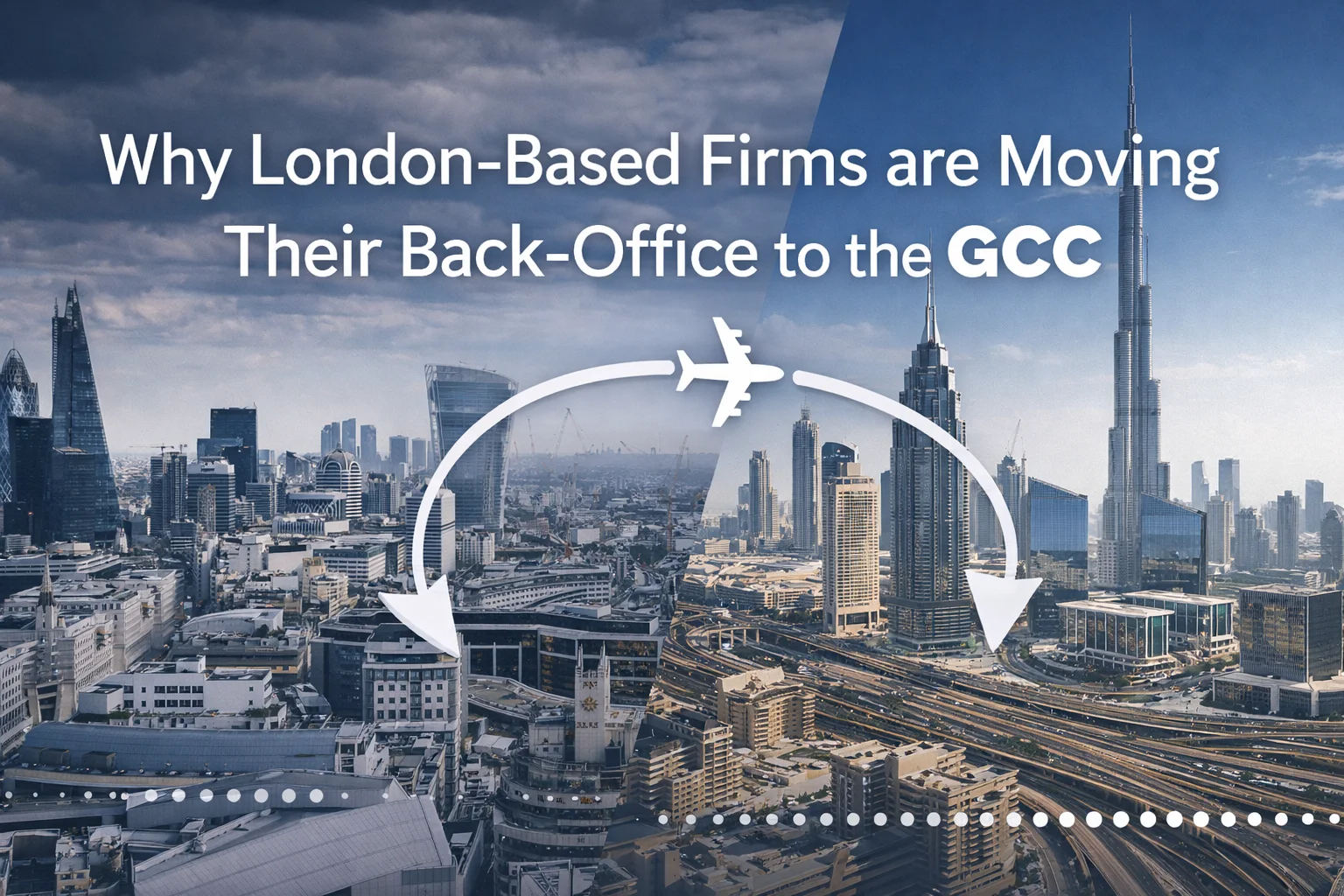
London firms are moving finance & accounting back-office to GCC. Lower costs, skilled talent, time zone advantage. Strategic shift accelerating.
Table of Contents
London Firms Are Moving Back-Office to GCC—Here’s Why It’s a Strategic Masterstroke
Picture this: It’s 8 AM in Mayfair. Frost glazes the windows of a centuries-old firm as the managing director sips her espresso. But her finance team isn’t down the hall—they’re wrapping up their day 3,000 miles away in Dubai, where the sun is setting over the Burj Khalifa. This isn’t science fiction; it’s the new reality for a growing number of London-based companies.
Why are established City firms, with deep roots in London’s financial ecosystem, packing up their back-office operations and replanting them in the Gulf Cooperation Council (GCC) nations like the UAE, Saudi Arabia, and Qatar? The answer is a compelling cocktail of post-Brexit pragmatism, economic vision, and a quest for operational excellence that is quietly rewriting the rulebook of global business.
More Than a Cost Play: The Strategic Landscape Shift
On the surface, the narrative seems familiar: lower costs. But to dismiss this trend as mere offshoring 2.0 is to miss the profound strategic recalibration at play. London remains a powerhouse for deal-making, client-facing roles, and high-stakes strategy. The GCC, however, has positioned itself as the optimal engine room.
This shift represents a deliberate decoupling of prestige from process. Firms retain their prestigious London addresses and front-office brilliance while leveraging the GCC’s unique advantages for everything from accounting and IT support to compliance and data analysis. It’s a hybrid model for a hybrid world.
The Brexit Catalyst and Beyond
Brexit acted as a forceful catalyst, introducing friction, uncertainty, and complexity into UK-EU operations. For finance and professional services firms, the regulatory divergence meant back-office functions like compliance reporting and client onboarding became suddenly more cumbersome and expensive to maintain solely in London.
Simultaneously, the GCC nations embarked on aggressive, well-funded campaigns to attract global business. The UAE’s 2023-2026 NextGenFDI initiative and Saudi Arabia’s Vision 2030 aren’t just slogans—they’re backed by tangible incentives like 100% foreign ownership, attractive tax regimes, and world-class infrastructure.
The Irresistible Pull of the GCC: A Multi-Factor Analysis
Let’s break down the magnetic forces pulling London’s back-office functions eastward.
The Economic Equation: Beyond Simple Savings
Yes, operational costs are lower. Office space, utilities, and certain administrative expenses can be significantly less than in Central London. However, the real economic win is in access to specialized talent without London’s premium price tag.
The GCC, particularly the UAE, has become a global talent magnet. You can recruit chartered accountants from India, fintech developers from Eastern Europe, and compliance experts from Asia—all within one jurisdiction, often with lower salary expectations than their London counterparts for a similar, if not higher, quality of life in the Gulf.
| Cost Factor | London (Central) | GCC (Dubai/Riyadh) | Strategic Implication |
|---|---|---|---|
| Senior Accountant Salary | £65,000 – £85,000 | AED 240,000 – 300,000 (~£50k-£63k) | Access equal talent for ~25% less |
| Prime Office Rent (psf/yr) | £100 – £150 | AED 1,200 – 1,800 (~£250-£380) | Modern space at a fraction of the cost |
| Corporate Tax Rate | 25% (from Apr 2023) | 0% (Free Zone) or 9% (Mainland) | Direct impact on group profitability |
The Geographic & Temporal Sweet Spot
The GCC’s location is a strategic masterstroke for firms serving a global clientele. It perfectly bridges the time-zone gap between London/Europe and Asia-Pacific.
- London Morning: Strategy set in HQ.
- GCC Afternoon: Back-office executes and delivers.
- Singapore/Hong Kong Evening: Output reaches APAC clients at start of their day.
This creates a near-24-hour operational cycle without graveyard shifts, boosting productivity and client responsiveness. As one London-based CFO I spoke with put it, “Waking up to completed reports from our Dubai team is a game-changer. It feels less like offshoring and more like time-travel.”
Regulatory Agility and Future-Proofing
The GCC’s regulatory environment is notably agile. Authorities in the UAE and Saudi Arabia are known for their business-friendly, responsive approach, often streamlining processes to attract and retain international firms. This contrasts with the increasingly complex and sometimes slower-moving regulatory frameworks in post-Brexit Europe.
Furthermore, establishing a substantive back-office in the GCC is a form of strategic future-proofing. It diversifies operational risk, creates a launchpad for Middle Eastern and Asian market expansion, and aligns the firm with the world’s fastest-growing economic regions.
The Human Touch: Voices from the Ground
This isn’t just about spreadsheets and strategy decks. I’ve spoken to several professionals who have lived this transition.
James, a Operations Director who moved from Canary Wharf to DIFC, shared: “There’s an energy here that’s hard to quantify. It’s the ambition in the air. My team in Dubai isn’t just processing invoices; they’re proactively suggesting process improvements because they feel they’re building something new, not just maintaining an old system.”
Aisha, a Senior Compliance Manager born in London but now working for a British firm in Riyadh, offered this perspective: “I’m using my UK training in a context that’s writing its own rulebook. It’s dynamic. For career growth, the opportunity to build functions from the ground up here is unparalleled compared to being a smaller cog in a giant, established London machine.”
These testimonials highlight a critical, often overlooked aspect: talent satisfaction and innovation. The GCC offers a fresh canvas, which can lead to higher engagement and proactive problem-solving from back-office teams.
Navigating the Nuances: It’s Not All Desert Roses
A prudent move requires eyes wide open. Cultural nuances, understanding local partnership laws (outside free zones), and managing a geographically split team require careful planning. The summer heat and a different social rhythm can be an adjustment for UK expats.
The key to success lies in robust local partnership. This is where firms like Crossfoot become invaluable. Navigating the setup—from choosing the right jurisdiction (Abu Dhabi’s ADGM vs. Dubai’s DIFC vs. Riyadh’s special economic zones) to handling local payroll, VAT, and compliance—requires on-the-ground expertise. Trying to manage it remotely from London is a recipe for friction.
The Verdict: A Structural Shift, Not a Fad
The movement of back-office functions from London to the GCC is more than a trend; it’s a structural response to a reshaped global economy. It combines cold financial logic with warm human ambition. London firms get to sharpen their competitive edge, reduce complexity, and tap into a vibrant talent pool. The GCC gains deeper economic integration, expertise, and validation of its business hubs.
For London, it’s not a loss, but an evolution. The City’s value is shifting higher up the value chain—towards innovation, leadership, and high-level client relationships. The “where” of the work is becoming less important than the “how” and the “why.”
Is Your Firm Considering the Shift?
If the question of “Why London-Based Firms are Moving Their Back-Office to the GCC” is now shifting to “How could we do this?” in your mind, the conversation starts with clarity.
At Crossfoot, we live at this intersection. With deep roots in both GCC operational excellence and an understanding of UK corporate needs, we help firms design and execute this transition seamlessly. We handle the accounting, compliance, and reporting complexities on the ground, so you can focus on the strategic benefits from your London HQ.
Let’s explore what this could look like for your firm. Contact our strategic advisory team today for a confidential consultation.