

Master financial due diligence for UAE mergers and acquisitions. Expert accounting tax and compliance support to protect your deal value.
Table of Contents
Financial Due Diligence Demystified: What Smart Investors Really Look For | Crossfoot
I remember sitting across from a client who was ready to acquire what seemed like a perfect manufacturing business. The financials showed consistent growth, healthy margins, and a solid customer base. The excitement in the room was palpable—until we dug deeper.
During our financial due diligence, we discovered something the seller’s glossy reports had carefully omitted: their largest client (representing 40% of revenue) was about to terminate their contract. The “consistent growth” was a house of cards waiting to collapse.
That moment changed how I view every transaction since. Financial due diligence isn’t just an administrative hurdle—it’s the critical process that separates successful investments from costly mistakes.
What Financial Due Diligence Really Is (And Isn’t)
Most people think of financial due diligence as number-crunching. Spreadsheets, ratios, profit margins. But in reality, it’s more like financial archaeology.
You’re not just verifying what’s presented. You’re uncovering what’s buried. You’re connecting dots between departments, between years, between what’s said in meetings and what’s shown in the books.
The Three Layers of Financial Due Diligence
| Layer | What It Examines | Common Pitfalls Missed |
|---|---|---|
| Surface Level | Reported financial statements, tax returns, basic ratios | Superficial compliance without substance |
| Operational Layer | Revenue quality, expense sustainability, working capital cycles | One-time gains disguised as recurring revenue |
| Strategic Layer | Customer concentration, market position, future viability | Dependency on key personnel or technology |
Why Traditional Financial Statements Can Deceive
I’ve seen beautifully formatted income statements hide fundamental flaws. Here’s what often gets overlooked:
Revenue Recognition Realities
A software company showed 300% year-over-year growth. Impressive, until we discovered they’d changed their revenue recognition policy to book multi-year contracts entirely upfront. Their actual cash flow told a very different story.
The “Quality of Earnings” Concept
This is where financial due diligence becomes an art. You’re not just asking “Are they profitable?” but “Why are they profitable—and is it sustainable?”
Example from our practice: A logistics company showed strong margins. But deeper analysis revealed they’d delayed all maintenance spending for two years. Those “profits” were actually future repair bills waiting to happen.
The Four Pillars of Effective Financial Due Diligence
Historical Analysis: Learning from Patterns
Look beyond the last three years. We typically analyze five-year trends because:
- One-off events become visible
- Strategic shifts reveal themselves
- Management consistency (or lack thereof) shows clearly
Key Question: Are the historical results a reliable predictor of future performance, or has the business been “dressed up” for sale?
Working Capital Examination: The Lifeblood Test
I once advised a client to walk away from a seemingly profitable retail acquisition. Why? Their working capital cycle was 120 days while the industry standard was 45. They were essentially financing their customers’ businesses.
Working Capital Health Check:
- Accounts Receivable: Aging analysis, collection patterns
- Inventory: Turnover rates, obsolescence risk
- Accounts Payable: Payment terms, supplier relationships
Liability Assessment: What’s Not on the Balance Sheet
The balance sheet shows formal debt. But what about:
- Operating leases (especially important post-IFRS 16)
- Warranty obligations
- Pending litigation
- Environmental cleanup responsibilities
- Unfunded pension liabilities
A manufacturing client we worked with discovered $2.3 million in environmental remediation costs that weren’t disclosed. The due diligence process saved them from inheriting someone else’s problem.
Future Viability: Stress-Testing the Business Model
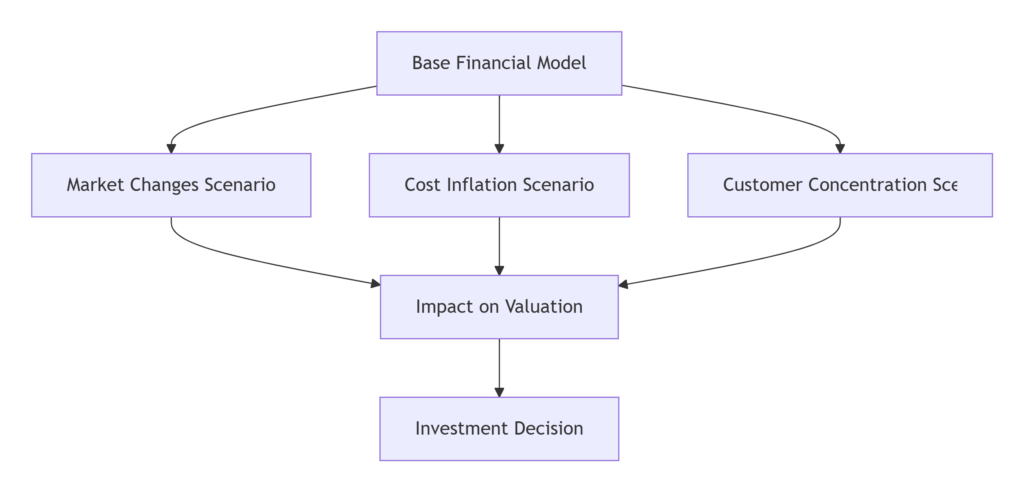
This is where financial due diligence meets strategy. We create multiple scenarios:
- Best case (market growth continues)
- Base case (current trends persist)
- Stress case (key customer loss, supply chain disruption)
Common Red Flags We’ve Uncovered
Through hundreds of engagements, certain patterns emerge:
The Hockey Stick Projection
Suddenly, after years of modest growth, next year’s forecast shows a 50% increase. Always ask: What specifically drives this change? New contracts? Market expansion? Often, it’s optimism disguised as strategy.
Related-Party Transactions
A distribution company showed excellent margins. We discovered they were buying exclusively from the CEO’s cousin’s company at above-market rates. The “profits” were being extracted through inflated costs.
Customer Concentration
The 80/20 rule applies here. If 80% of revenue comes from 20% of customers, you’re not buying a business—you’re buying relationships. And relationships can leave.
The Human Element: Management Interviews Matter
Numbers tell part of the story. People tell the rest. During management interviews, we listen for:
- Consistency between what’s said and what’s documented
- Depth of knowledge about the business
- Transparency about challenges
- Alignment between leadership team members
I recall interviewing a management team where the CFO and COO gave completely different explanations for inventory increases. That discrepancy led us to discover unauthorized stockpiling that was about to become obsolete.
Technology’s Role in Modern Due Diligence
Today’s tools allow us to go deeper, faster:
Data Analytics Platforms
We can now analyze every transaction in a database, not just samples. This revealed for one client that “seasonal fluctuations” were actually specific customers delaying payments every third quarter.
Digital Document Review
AI-powered tools help identify inconsistencies across hundreds of documents that human reviewers might miss.
Visualization Tools
Complex financial relationships become clear through interactive dashboards, helping stakeholders understand implications quickly.
Cross-Border Considerations
In our work across the UAE and broader GCC region, we’ve learned that financial due diligence must adapt to local contexts:
Cultural Nuances
- Relationship-based business practices
- Different documentation standards
- Varied interpretations of agreements
Regulatory Differences
- VAT and excise tax implications (critical in UAE)
- Ownership restrictions in certain sectors
- Local accounting standards vs. IFRS
Practical Tip: Always engage local experts who understand both the numbers and the cultural context. What looks like a red flag in one market might be standard practice in another.
When Due Diligence Reveals Opportunities
It’s not just about finding problems. Often, financial due diligence uncovers hidden value:
Case Study: The Undervalued Asset
A client was acquiring a logistics company. The due diligence revealed they owned three warehouses in rapidly appreciating areas. The real estate was carried at historical cost on the books. The hidden asset value exceeded the purchase price.
Operational Improvements
By analyzing cost structures, we often identify efficiency opportunities that make the acquisition more valuable than originally estimated.
The Cost of Skipping Proper Due Diligence
The statistics are sobering:
- 70-90% of acquisitions fail to deliver expected value (Harvard Business Review)
- Inadequate due diligence is cited as a primary reason
- The average overpayment in poorly vetted deals is 20-30%
But beyond statistics, I’ve seen the human cost: entrepreneurs losing lifetime savings, employees losing jobs, families under stress. Proper financial due diligence isn’t just about protecting money—it’s about protecting people’s futures.
Implementing Findings: The Real Challenge
Discovering issues is only half the battle. The real value comes from:
- Quantifying the impact
- Negotiating adjustments
- Developing mitigation plans
- Monitoring post-acquisition
We helped a client renegotiate a purchase price down by 35% after discovering unrecorded liabilities. But more importantly, we helped them structure an earn-out that aligned payments with actual performance.
Conclusion: Due Diligence as a Mindset
Financial due diligence shouldn’t end when the deal closes. The most successful investors we work with maintain a “due diligence mindset” continuously.
They’re always asking:
- What assumptions underlie our financial projections?
- What risks are we not seeing?
- How would this business look to someone seeing it for the first time?
This mindset transforms financial due diligence from a transactional exercise to a strategic capability.
Your Next Step
Whether you’re considering an acquisition, seeking investment, or planning your exit strategy, the principles of thorough financial due diligence apply.
At Crossfoot, we’ve guided hundreds of clients through this critical process. We bring not just accounting expertise, but the judgment that comes from seeing what works—and what doesn’t—in real transactions.
Ready to look beyond the numbers? Contact our M&A advisory team for a confidential discussion about your specific situation. Let’s ensure your next transaction is built on solid financial understanding, not just hope and spreadsheets.