

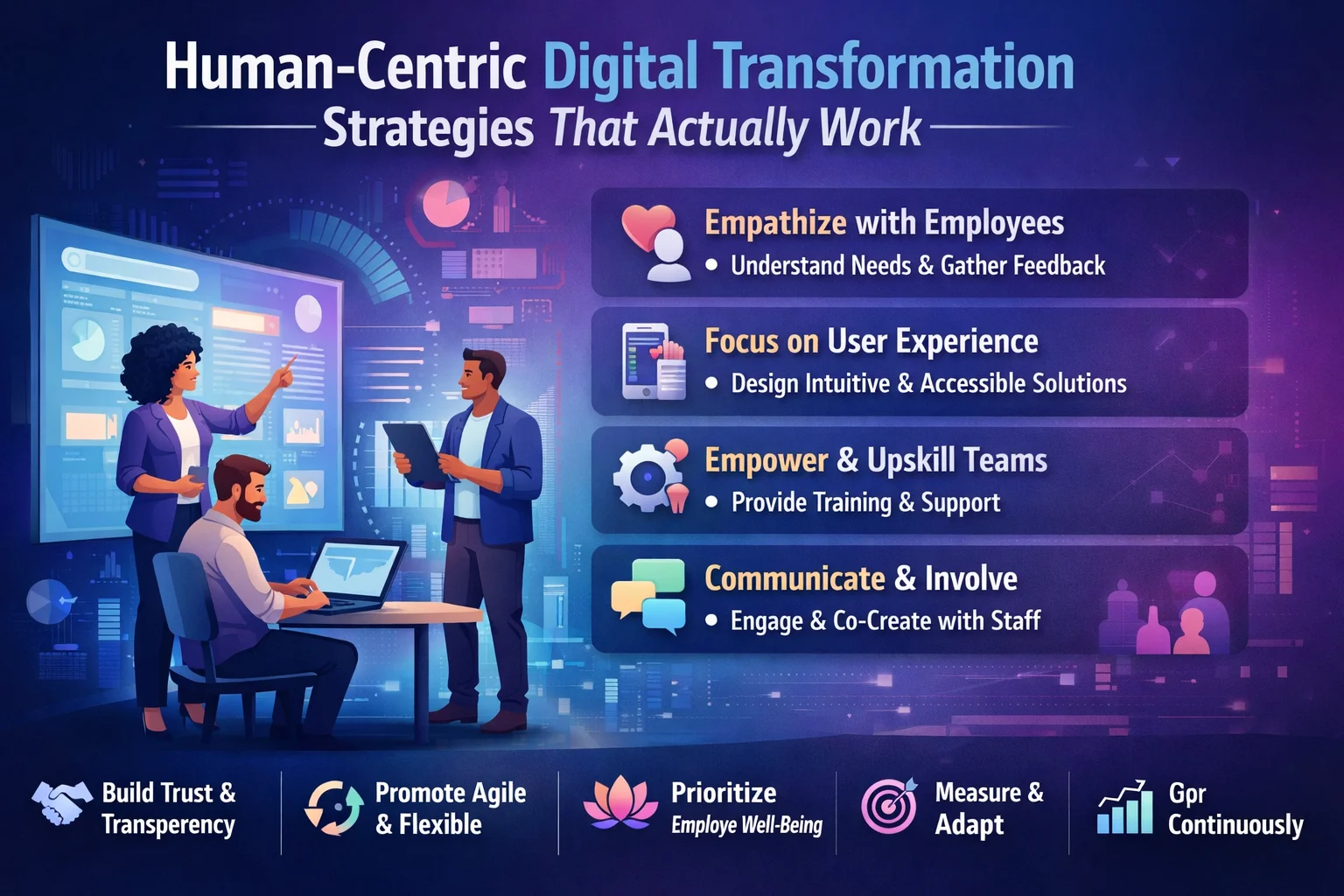
Human-Centered Digital Transformation Strategies that put people first. Boost adoption, reduce resistance, and drive real business results.
Table of Contents
Human-Centered Digital Transformation Strategies That Actually Work
I remember sitting across from the CEO of a once-thriving retail chain as he scrolled through his phone, showing me photos of empty store shelves. “We spent half a million on a new inventory system,” he confessed, his voice heavy with frustration. “The consultants promised it would revolutionize everything. Now my staff can’t use it, my customers are confused, and my inventory is still a mess.”
This story isn’t unique. According to McKinsey, a staggering 70% of digital transformations fail to meet their objectives. Why? Because too many companies treat digital transformation as a technology problem rather than a human one.
The most effective digital transformation strategies aren’t about chasing the latest tech trends. They’re about fundamentally reimagining how people work, collaborate, and create value. They’re about building bridges between technology and human potential.
What Digital Transformation Really Means (And What It Doesn’t)
The Misunderstood Concept
Digital transformation has become one of the most overused—and misunderstood—terms in business today. It’s not simply:
- Buying new software
- Moving to the cloud
- Creating a mobile app
- Automating routine tasks
True digital transformation is a fundamental rethinking of how an organization uses technology, people, and processes to create new value. It’s cultural change enabled by technology, not the other way around.
A Personal Perspective
Early in my career, I worked with a manufacturing company implementing a “transformative” ERP system. The technology was impressive, but we failed to consider how the floor supervisors—some with 30 years of experience—would adapt. We optimized for data collection rather than human workflow.
The result? Experienced workers retired early, quality control suffered, and the promised efficiency gains never materialized. We learned the hard way that transformation without adoption is just expensive software.
The Four Pillars of Human-Centered Transformation
Culture First, Technology Second
Harvard Business Review research shows that cultural and behavioral challenges are the biggest barriers to digital success. Before you invest in technology, ask:
- Are our leaders digitally literate?
- Do we reward experimentation or punish failure?
- Is collaboration part of our DNA?
Practical Action: Start with a “digital maturity assessment” that evaluates culture alongside technology. Use anonymous surveys to understand employee readiness and concerns.
Customer Obsession as Your North Star
Amazon’s famous “empty chair” practice—leaving an empty chair in meetings to represent the customer—illustrates this principle perfectly. Your digital transformation strategies should answer one question: How does this improve our customer’s experience?
| Traditional Approach | Customer-Obsessed Transformation |
|---|---|
| Automating internal processes | Streamlining customer journeys |
| Reducing operational costs | Increasing customer lifetime value |
| Implementing what competitors have | Solving unmet customer needs |
Agile Mindset Over Waterfall Projects
The days of multi-year transformation programs are over. Successful organizations adopt agile principles:
- Start with minimum viable products (MVPs)
- Test, learn, and iterate rapidly
- Empower cross-functional teams
Real Example: A financial services client of ours wanted to overhaul their client portal. Instead of a two-year development cycle, we launched a basic version in 90 days, then improved it based on actual user feedback every two weeks. Within six months, adoption rates tripled.
Data Literacy as a Core Competency
Data isn’t just for analysts anymore. When we helped a Dubai-based logistics company with their transformation, we made data literacy training mandatory for everyone—from truck dispatchers to the CEO.
The result? Frontline employees started identifying route optimization opportunities. Customer service reps predicted delivery issues before clients called. Data stopped being “IT’s responsibility” and became “everyone’s tool.”
Common Pitfalls in Digital Transformation Strategies
The Technology Trap
Many organizations make the critical mistake of starting with technology selection. They ask, “Which CRM should we buy?” rather than “What customer relationships do we want to enable?”
The Silo Syndrome
When marketing implements a new automation platform independently from sales’ CRM implementation, customers get fragmented experiences. True transformation requires breaking down departmental barriers.
The Training Fallacy
Rolling out new technology with a single training session is a recipe for failure. According to Gartner, effective digital adoption requires continuous, context-sensitive learning integrated into daily workflows.
Building Your Transformation Roadmap: A Practical Framework
Phase : Diagnosis and Vision (Weeks 1-4)
- Conduct current-state assessment
- Define “why” behind transformation
- Identify quick wins to build momentum
- Secure executive alignment
Phase : Design and Experimentation (Months 2-4)
- Form cross-functional “transformation pods”
- Develop customer journey maps
- Create and test MVPs
- Establish metrics for success
Phase : Scale and Integrate (Months 5-12)
- Roll out successful experiments
- Update processes and policies
- Implement change management programs
- Develop internal champions
Phase : Optimize and Evolve (Ongoing)
- Continuous improvement cycles
- Regular capability assessments
- Technology refresh planning
- Culture reinforcement
The Human Element: Change Management That Actually Works
Communication Is Everything
During a recent transformation project with a Saudi-based family business, we discovered that middle managers were the critical success factor. They weren’t resisting change—they simply didn’t understand how to explain it to their teams.
We created “manager playbooks” with simple talking points, FAQs, and workshop guides. We gave them permission to say “I don’t know” and provided channels to get answers quickly. This simple intervention increased employee adoption by 40%.
Measuring What Matters
Traditional metrics like ROI and implementation timelines matter, but don’t forget human metrics:
- Employee net promoter score (eNPS)
- Technology adoption rates
- Cross-departmental collaboration frequency
- Innovation experiment volume
The Middle East Context: Unique Opportunities and Challenges
Having worked with businesses across the Gulf region, I’ve observed several unique factors:
Opportunities:
- Younger, digitally-native populations
- Government-led digital initiatives (like Saudi Vision 2030)
- Less legacy system baggage than some Western counterparts
Challenges:
- Rapid growth can outpace digital maturity
- Cultural considerations around change management
- Talent gaps in specialized digital skills
Technology Considerations: What Actually Matters
The Stack That Supports Transformation
Don’t get distracted by buzzwords. Focus on technology that enables:
- Integration over isolated solutions
- Flexibility over rigid systems
- User experience over feature lists
- Data fluidity over data collection
https://images.unsplash.com/photo-1551288049-bebda4e38f71?auto=format&fit=crop&w=1200
Successful transformation balances technology, processes, and people
When to Seek External Help (And When Not To)
DIY Transformation Works When:
- You have strong internal digital leadership
- The transformation scope is limited
- Your culture embraces experimentation
- You have previous transformation experience
Consider Partners When:
- You’re entering unfamiliar territory (AI, IoT, blockchain)
- Internal resistance is high
- You need specialized skills quickly
- Objectivity is crucial for cultural assessment
At Crossfoot, we’ve found the most success with a co-creation model—building capabilities alongside our clients rather than doing transformation “to” them.
Conclusion: Transformation as Journey, Not Destination
The most successful digital transformation strategies recognize one fundamental truth: Transformation is never “done.” It’s a continuous evolution—a new way of thinking and operating.
That retail CEO I mentioned earlier? We worked together to implement a phased approach that started with his employees’ biggest pain points. We co-designed solutions with the people who would use them daily. We celebrated small wins publicly.
A year later, he sent me a different photo: his team gathered around a dashboard they’d helped design, pointing at metrics they now understood and owned. The technology was simpler than originally planned, but the human impact was transformational.
Your Next Step: From Reading to Doing
Digital transformation strategies succeed when they move from abstract concepts to concrete actions. Start small, but start today:
- Identify one customer pain point you can address in the next 90 days
- Talk to three frontline employees about their daily frustrations
- Run one controlled experiment with clear success criteria
- Share what you learn—whether you succeed or fail
At Crossfoot, we’ve helped numerous businesses navigate this journey. We’ve seen firsthand that the organizations that thrive aren’t necessarily the most technologically advanced—they’re the most human-centered.
Ready to transform how you transform? Let’s have a conversation about your unique challenges and opportunities. Contact our digital transformation specialists for a no-obligation assessment of where you are—and where you could go.
About the Author
With over 15 years of experience guiding businesses through digital evolution across the Middle East, our team at Crossfoot combines technical expertise with deep human understanding. We believe numbers tell only half the story—the other half is written by people.