

Stop guessing. Learn high-level business planning to map your 5-year “Mount Everest” strategy. Expert insights from Crossfoot.
Table of Contents
High-Level Business Planning: Defining Your 5-Year “Mount Everest”
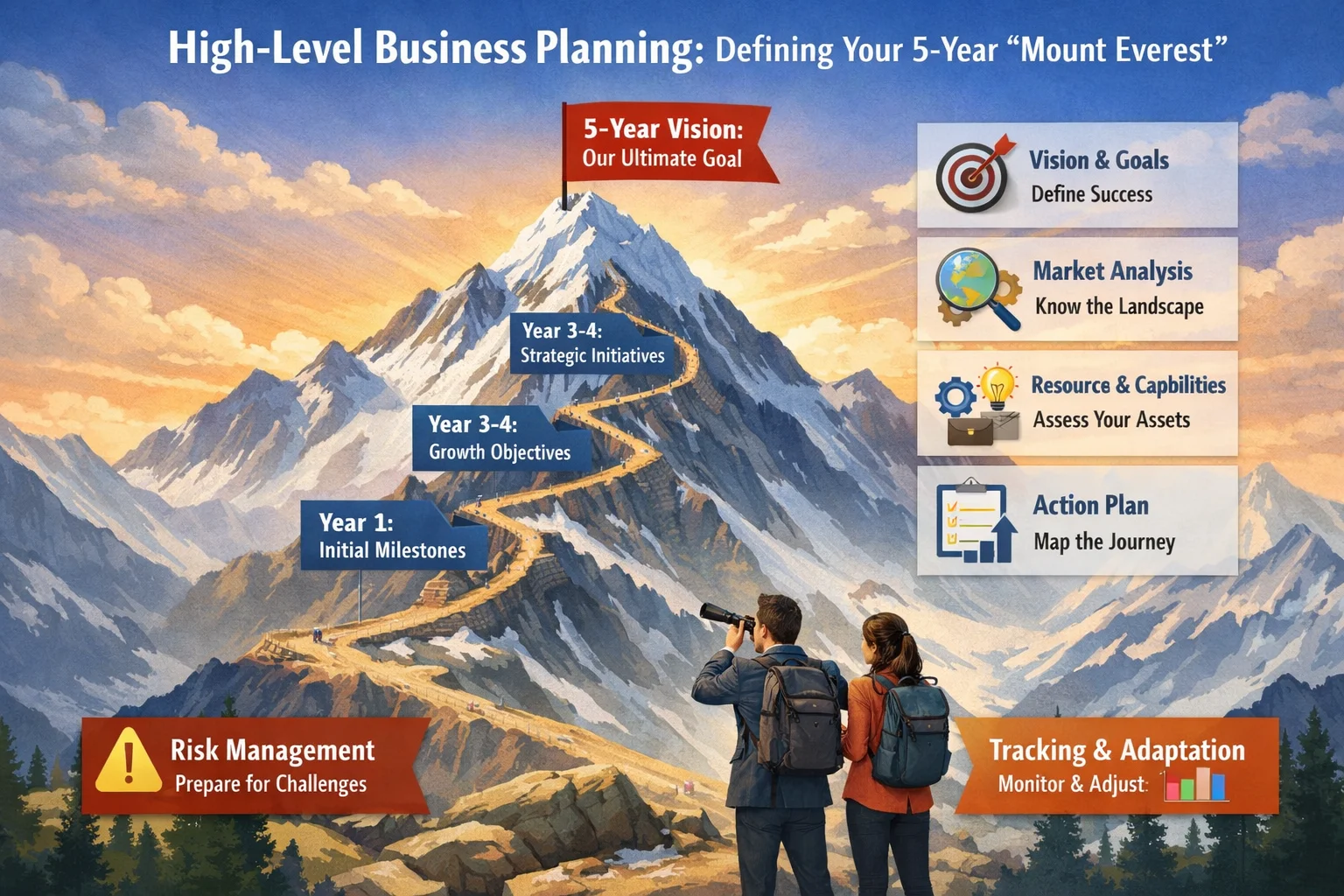
Imagine standing at base camp, looking up at a distant, cloud-shrouded peak. It’s majestic, intimidating, and seems almost unreachable. That peak isn’t a mountain—it’s your company’s ultimate potential. High-level business planning is the process of choosing that peak, charting the route, and preparing your team for the long, arduous, and rewarding climb.
Most business owners plan one summit at a time: next quarter’s revenue, this year’s product launch. But true, transformative growth happens when you lift your gaze beyond the immediate foothills to the horizon. It happens when you define your 5-Year “Mount Everest.”
This isn’t about vague dreams of “being successful.” It’s a deliberate, strategic process of defining what ultimate success looks like for your unique venture, and then reverse-engineering the path to get there. Let’s map your expedition.
Why “Mount Everest”? The Psychology of a Compelling Vision
A 5-year financial target is a number. A “Mount Everest” is a story. It’s a visceral, tangible vision that does more than guide—it inspires.
- It Creates Alignment: When every team member understands the ultimate peak, their daily tasks gain purpose. The marketer isn’t just running ads; they’re securing oxygen for the climb. The developer isn’t just coding; they’re forging a new path up the mountain.
- It Drives Resilience: The journey will have crevasses (market downturns) and blizzards (failed initiatives). A powerful “why” is what keeps the team moving when the path gets tough. Research from Harvard Business Review on purpose-driven companies shows they retain talent better and recover from setbacks faster.
- It Filters Decisions: With a clear peak in sight, every opportunity can be evaluated with one question: “Does this get us closer to the summit, or is it a distracting detour?” This clarity is the cornerstone of effective strategic management.
Your Everest could be:
- Becoming the recognized market leader in your niche.
- Achieving a specific revenue milestone that allows for a significant exit or legacy shift.
- Revolutionizing a standard industry practice.
- Expanding operations to three new countries.
The key is specificity. “Become bigger” is a hill. “Become the leading provider of sustainable packaging in the MENA region by 2029” is a peak you can plot on a map.
Base Camp Assessment: Knowing Where You Stand Before the Climb
You cannot plot a course to a new destination without first accurately pinpointing your current location. This is the often-skipped, crucial phase of high-level business planning.
Conduct a brutally honest assessment:
- Internal Terrain (Your Resources): What are your core strengths? Where are your skill gaps? Is your financial foundation (cash flow, profitability) solid enough to fund the expedition?
- External Weather (The Market): What are the prevailing winds (market trends)? Who else is on the mountain (competitive landscape)? Are there approaching storms (regulatory changes, technological disruptions)?
Tools like a SWOT Analysis (Strengths, Weaknesses, Opportunities, Threats) or a comprehensive business health check, like the kind we provide at Crossfoot, can turn this assessment from a guessing game into a data-driven map.
Charting the Route: The Four Camps of Your 5-Year Plan
With your peak chosen and your base camp established, it’s time to chart the route. Break the 5-year journey into manageable “camps” or phases. This transforms an overwhelming climb into a series of achievable missions.
| Camp (Year) | Strategic Focus | Key Questions to Answer |
|---|---|---|
| Camp 1 (Y1) | Foundation & Validation | Have we validated our core path? Are our financial systems and team robust for the climb ahead? |
| Camp 2 (Y2) | Efficient Ascent | Are we scaling our proven processes? How are we optimizing resources and building momentum? |
| Camp 3 (Y3) | The Death Zone Push | This is the hardest push. Are we making the bold investments needed for the final summit? Is the team equipped for the altitude? |
| Camp 4 (Y4-5) | Summit & New Horizons | Have we achieved the peak? What does sustaining success look like? What’s the next mountain on the horizon? |
Each camp requires specific resources, milestones (like hitting a certain revenue target or market share), and a clear signal to move to the next phase. This phased approach is central to agile business strategy, allowing for adjustment without losing sight of the ultimate goal.
Packing Your Sherpa Team: Aligning Talent & Culture
You would never climb Everest alone. You need a trusted team of Sherpas—experts who know the terrain better than anyone.
In business, your “Sherpas” are your key talent and your culture.
- Strategic Hiring: Are you hiring for the next camp, or just for today’s base camp? Look for skills and mindsets that will be crucial 2-3 years from now.
- Culture as Oxygen: A toxic culture is like thin air—it saps energy, causes conflict, and can be fatal to the mission. Foster a culture of resilience, clear communication, and shared purpose. It’s the oxygen that sustains your team at high altitudes.
Navigating the Crevasses: Risk Management & Financial Forecasting
The Khumbu Icefall on Everest is notoriously dangerous, constantly shifting. The business landscape is no different.
Your high-level business plan must include a dedicated risk assessment:
- Financial Crevasses: Runway burn rate, customer concentration, economic cycles.
- Operational Avalanches: Key person risk, supply chain failure, technology obsolescence.
- Strategic Whiteouts: New competitors, paradigm-shifting innovations.
This is where budgeting, forecasting, and cost control move from accounting tasks to survival skills. A detailed, rolling financial forecast is your weather report and icefall map combined. It helps you anticipate cash flow gaps, model different scenarios (“What if we lose our biggest client?”), and ensure resources are allocated to the most critical ropes and ladders. It’s not about predicting the future perfectly; it’s about being prepared for its many possibilities.
The Summit View: Measuring What Truly Matters
Reaching the summit isn’t just about planting a flag. It’s about the view—the new perspective it grants you.
Your key performance indicators (KPIs) are your altimeters. But beyond standard metrics like revenue and profit, define “summit metrics” that align with your Everest:
- If your peak is market leadership, track market share and brand sentiment.
- If your peak is innovation, track patents filed or RROI (R&D Return on Investment).
- If your peak is impact, track social or environmental metrics alongside financial ones.
Regular “acclimatization checks”—quarterly and annual strategic reviews—are essential. Use these not just to report numbers, but to ask: Are we still on the best route? Do we need to adjust for new conditions? Is the team healthy and aligned?
Your Next Step: From Vision to Map
Defining your 5-Year Everest is the most inspiring work a leader can do. But the gap between a visionary peak and a actionable map is where most expeditions fail.
This is where expertise matters. The journey requires more than passion; it requires precise navigation, resource management, and the ability to read the changing landscape.
At Crossfoot, we specialize in translating visionary peaks into strategic maps. We partner with business leaders as their strategic Sherpas, providing the management reporting, financial insights, and high-level planning frameworks needed to turn a daunting 5-year vision into a confident, step-by-step ascent.
We help you answer the critical questions: Is our financial base camp secure? Do our forecasts account for the icefalls ahead? Are our resources packed for the next camp?
Ready to define your Everest and chart the route? Contact Crossfoot today for a complimentary Business Health Assessment. Let’s build a strategic plan that is as inspiring as it is executable. Your summit awaits.