

Table of Contents
Understanding the Different Types of Taxes: A Comprehensive Guide for Businesses and Individuals
Introduction
Remember the first time you looked at your payslip and wondered where a chunk of your hard-earned money disappeared? Or perhaps you’ve stared at a receipt, puzzled by the additional “VAT” charge at the bottom. If these moments have left you curious about where your money goes, you’re not alone. Taxes are an inevitable part of our financial lives, yet many of us don’t fully understand the different types of taxes we encounter daily.
Taxes have existed for thousands of years—the earliest known taxes were those of the Egyptian Old Kingdom, funding the construction of pyramids and the administration of ancient civilizations . Today, they remain the primary way governments fund everything from healthcare and education to roads and national defense . But here’s the thing: not all taxes work the same way. Some take a chunk of your paycheck, others appear when you shop, and some only matter if you own property or pass on wealth to your children.
In this guide, we’ll demystify the complex world of taxation, drawing on both timeless principles and current practices from around the globe. Whether you’re a business owner in Dubai, a salaried professional in London, or simply someone trying to make sense of your household budget, understanding these distinctions will help you navigate your financial world with greater confidence.
The Big Picture: Direct vs. Indirect Taxes
Before diving into specific categories, it helps to understand the fundamental classification that economists and tax professionals use. Taxes are broadly divided into two main camps: direct taxes and indirect taxes .
Think of direct taxes as the ones that come straight out of your pocket—they’re paid directly to the government by the person or entity on whom they’re imposed. Income tax is the classic example. You earn money, you pay the tax directly. No middleman .
Indirect taxes, on the other hand, take a detour. They’re imposed on goods and services rather than on people directly. When you buy a coffee, the price includes VAT or sales tax, which the shop collects and passes on to the government. You’re paying the tax, but not directly to the tax authority .
This distinction matters because it affects who bears the ultimate burden of the tax—and how that burden feels to different segments of society.
The Main Types of Taxes You’ll Encounter
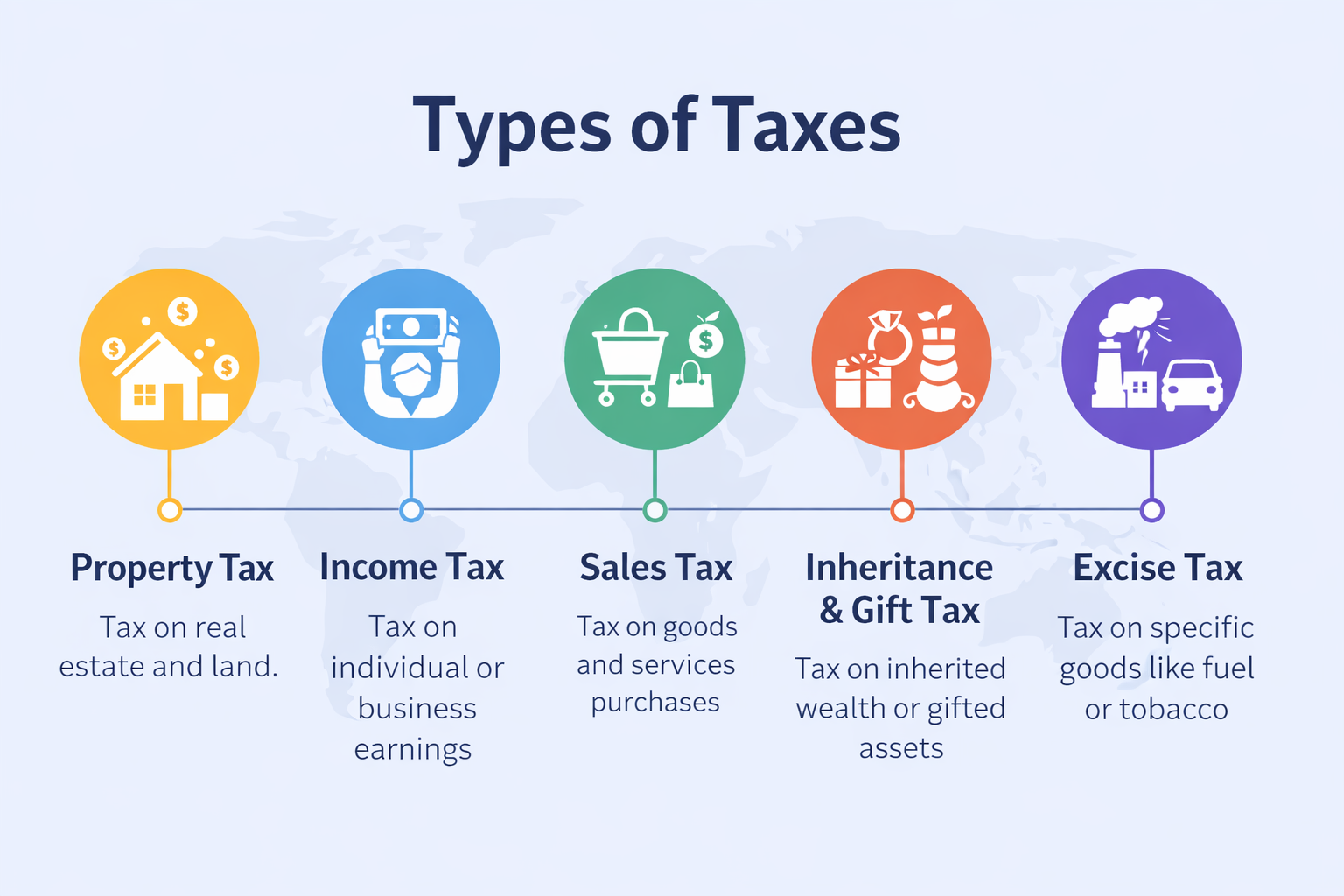
1. Individual Income Tax
This is the tax most people know intimately. Individual income tax is levied on the total personal net income of a taxpayer—wages, salaries, investment returns, and other earnings .
What makes income tax interesting is how differently countries approach it. In most developed nations, income tax is progressive, meaning the rate increases as your income rises . The logic is straightforward: those with greater ability to pay contribute a larger percentage.
For example, in countries like India and the United States, tax brackets look something like this :
- Lower incomes: 5-10%
- Middle incomes: 20-25%
- Highest incomes: 30-40%
However, some countries take a radically different approach. The United Arab Emirates, for instance, levies no personal income tax at all . This absence of personal income tax is one reason Dubai has become a global hub for expatriate professionals.
2. Corporate Income Tax
Businesses don’t escape the tax net either. Corporate income tax is levied on company profits—the money left after paying expenses, salaries, and other costs .
Corporate tax rates vary dramatically worldwide. Ireland has attracted countless multinational companies with its 12.5% rate, while other developed nations hover around 20-30% . The UAE introduced a federal corporate tax in 2023, applying a 9% rate on business profits above AED 375,000—a move designed to align with international tax standards while remaining competitive .
3. Consumption Taxes: VAT and Sales Tax
Here’s where taxes touch our daily lives most visibly. Consumption taxes apply when we spend money rather than when we earn it.
Value Added Tax (VAT) is collected at each stage of production and distribution, with businesses claiming credits for tax paid on their inputs . The end consumer ultimately bears the cost. VAT rates in the European Union averaged around 19% in 2022, though individual countries set their own rates within EU guidelines .
Sales tax, common in US states, is typically collected only at the point of final sale to consumers . Unlike VAT, there’s no credit mechanism for businesses along the supply chain.
Consumption taxes are often called regressive because they take a larger percentage of income from low-earners than from high-earners . A 10% tax on groceries affects someone earning AED 3,000 per month much more painfully than someone earning AED 30,000.
4. Excise Taxes: Targeting Specific Goods
Excise taxes deserve special mention because they’re deliberately designed to influence behavior. These are indirect taxes charged on the sale of particular goods—typically products considered harmful or luxurious .
Common excise targets include:
- Tobacco products (often taxed at 100% or more)
- Alcoholic beverages
- Energy drinks and sugary beverages
- Fuel and energy products
- Gambling and lottery tickets
In the UAE, excise tax reaches 100% on tobacco and energy drinks, and 50% on carbonated and sweetened beverages. These high rates serve a dual purpose: generating revenue while discouraging consumption of products linked to health problems .
5. Property Taxes
If you own a home or land, property taxes likely feature in your financial life. These are taxes based on how much a person owns—typically calculated as a percentage of the property’s value .
Property taxes fund local services like schools, police, fire departments, and infrastructure maintenance . In many countries, they’re assessed annually by municipal or regional governments. The United Kingdom’s Council Tax, for instance, is a form of property tax that varies based on property value bands.
6. Taxes on Wealth Transfer
Death may be certain, but taxes on death vary considerably. Inheritance tax applies to what beneficiaries receive from an estate, while estate tax applies to the total value of the deceased person’s estate before distribution .
Some countries also impose gift taxes to prevent people from avoiding death duties by transferring wealth before death . These taxes remain controversial—critics call them “death taxes” and argue they represent unfair double taxation on money already taxed during the owner’s lifetime.
7. Customs Duties and Tariffs
When goods cross international borders, customs duties often apply. These are taxes on imported goods, historically designed to protect domestic industries by making foreign products more expensive .
In our interconnected global economy, customs duties shape trade relationships and supply chains. The European Union, for example, maintains a common external tariff that applies to goods entering any member state .
How Tax Systems Differ: Progressive, Regressive, and Proportional
Beyond specific tax types, the overall system design reveals a society’s values and priorities. Tax systems generally fall into three categories .
Progressive Taxation
As income rises, a larger percentage is paid in tax . This approach aims to reduce inequality by asking more from those with greater resources. Most developed countries use progressive income tax systems.
The benefit? Greater revenue for public services and social programs. The challenge? High earners may feel penalized and engage in tax planning—or relocate to lower-tax jurisdictions .
Regressive Taxation
As income rises, a smaller percentage is paid in tax . This sounds counterintuitive, but it happens when taxes aren’t based on income. Consumption taxes like VAT are regressive because low-income households spend a larger proportion of their earnings on taxable goods.
In the United States, the bottom 20% of income earners pay as much as six times the percentage of their income in state and local taxes compared to the top 20% .
Proportional Taxation (Flat Tax)
Everyone pays the same percentage, regardless of income level . This simplicity appeals to many reformers. Russia famously adopted a 13% flat income tax, and several Eastern European countries followed suit .
The UAE’s 9% corporate tax is flat—all qualifying businesses pay the same rate above the threshold . The advantage is straightforward compliance; the drawback is that it doesn’t address income inequality.
Most countries actually operate hybrid systems. India combines progressive personal income tax with regressive GST. The United States has progressive federal taxes alongside regressive state sales taxes. The UAE maintains no personal income tax alongside flat corporate tax and selective excise duties .
Why Understanding Tax Types Matters for Your Business
For business owners and entrepreneurs, grasping these distinctions isn’t academic—it’s essential for survival and growth.
Compliance costs money. Misclassifying products for excise tax purposes or misunderstanding VAT obligations can trigger penalties. The UAE’s Federal Tax Authority imposes significant fines for late registration, incorrect filings, or underpayment .
Tax structure affects pricing. Whether you’re importing goods subject to customs duties or selling products with excise tax, understanding your cost base lets you price intelligently while maintaining margins.
Planning opportunities exist. Legitimate tax planning—distinct from evasion—can reduce your effective tax rate. Choosing appropriate business structures, timing transactions, and understanding available reliefs all require tax knowledge.
Cross-border operations multiply complexity. If you’re trading with EU countries, dealing with their VAT systems adds layers of consideration. If you’re expanding to Saudi Arabia, their tax treaties with the UAE affect your structure .
Practical Steps for Tax Compliance
Based on years of helping businesses navigate tax obligations, here’s practical advice:
Know your thresholds. Many taxes apply only above certain limits. UAE corporate tax, for instance, only applies to profits exceeding AED 375,000 . Below that, you’re outside the scope.
Maintain impeccable records. Tax authorities everywhere require documentation. The UAE mandates keeping records for five years . Digital systems that automatically track transactions save headaches during audit seasons.
Understand your product classifications. Excise tax applies to specific goods defined by customs codes. Misclassifying a product can mean either overpaying tax or facing penalties for underpayment.
Stay current with changes. Tax laws evolve constantly. The UAE expanded excise tax to sweetened drinks in 2020, adding new compliance burdens for beverage companies . What’s true today may change tomorrow.
Seek professional guidance. Tax complexity grows with business scale. While small operations might manage with software tools, growing businesses benefit from expert advice tailored to their specific circumstances.
Conclusion
Taxes aren’t going anywhere—they’re the price of civilized society, funding the infrastructure and services we all rely on. But understanding the different types of taxes transforms them from mysterious deductions into predictable, manageable business costs.
From direct taxes on income and profits to indirect taxes on consumption and specific goods, each type serves distinct purposes and creates different economic effects. Progressive systems aim for equity; flat systems prioritize simplicity; regressive taxes (usually unintentionally) burden lower incomes more heavily.
For business owners in the UAE and beyond, this knowledge translates directly to better decisions. When you understand why you’re paying what you’re paying, you can plan effectively, comply confidently, and focus your energy on what really matters: growing your business.
At Crossfoot, we’ve helped hundreds of businesses navigate the complex landscape of UAE taxation—from corporate tax registration to excise compliance and VAT filing. Our team combines technical expertise with practical business sense, translating tax obligations into actionable strategies rather than burdensome requirements.
Ready to take control of your tax obligations? Contact our team today for a complimentary consultation. Whether you’re struggling with excise tax classification, preparing for corporate tax filing, or simply wanting peace of mind that your compliance is handled correctly, we’re here to help you focus on your business while we handle the numbers.