

Table of Contents
Global Corporate Structure Tax UAE: A Strategic Guide for Multinationals in 2026
Introduction
Ahmad was the CFO of a mid-sized logistics group that had, for nearly a decade, used its Dubai free zone entity as a regional treasury and holding hub. The structure was lean, efficient, and, until last year, virtually tax-free. Then came the audit. Not a full-scale investigation, but a routine data request from the Federal Tax Authority asking for a jurisdictional effective tax rate calculation under the new Domestic Minimum Top-Up Tax (DMTT) rules.
“We thought the 9% corporate tax was the end of it,” Ahmad told me recently. “We didn’t realize that for a group our size, the real number to watch is 15%.”
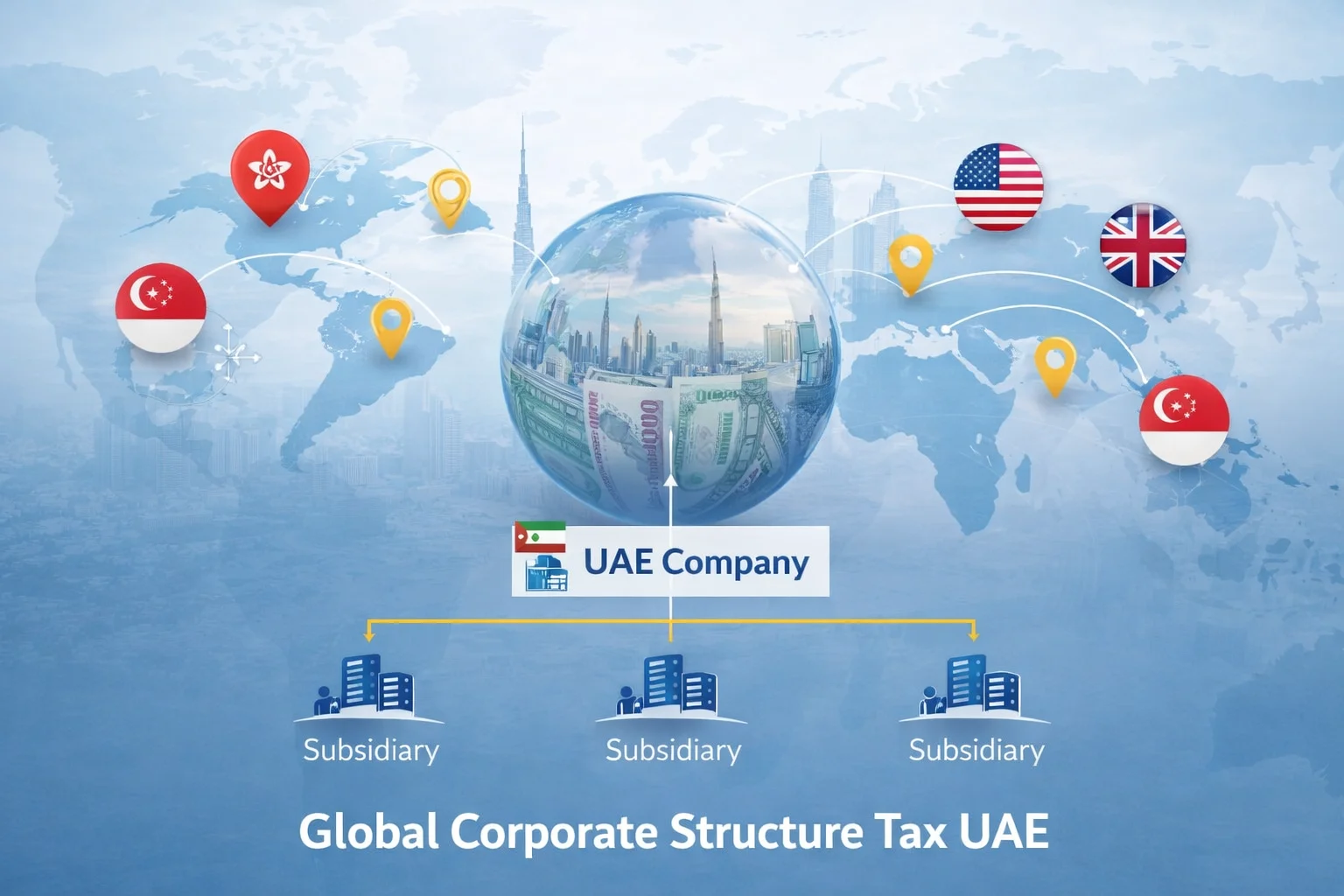
Ahmad’s realization is becoming increasingly common. The UAE’s tax landscape has shifted dramatically, and understanding global corporate structure tax UAE implications is no longer optional for multinational enterprises. This article unpacks what’s changed, why it matters, and how forward-thinking businesses are adapting.
The New Reality: Why 2025 Changed Everything
The UAE has long been perceived—and rightly so—as an efficient hub for regional and international group structures with low tax rates. However, it’s time to recalibrate that perception .
From 1st January 2025, the UAE implemented a 15% Domestic Minimum Top-Up Tax (DMTT) for multinational enterprise groups with consolidated global revenue of €750 million or more in at least two of the previous four financial years . This isn’t a minor adjustment; it’s a structural shift meant for large multinational groups operating in or through the UAE.
Who This Actually Applies To
Let me be clear about the scope, because there’s confusion in the market:
| Criterion | Detail |
|---|---|
| Revenue Threshold | €750 million+ consolidated group revenue in at least 2 of previous 4 years |
| Applicable Entities | Constituent entities of in-scope multinational groups in/through UAE |
| Effective Date | Financial years beginning on or after 1 January 2025 |
| Calculation Basis | Jurisdictional effective tax rate under GloBE rules (not just the 9% rate) |
The 9% UAE corporate tax framework remains in place for everyone else. But for in-scope groups, the analysis has fundamentally shifted from the statutory rate to the jurisdictional effective tax rate under GloBE calculations .
What This Means for Your Corporate Structure
Here’s where the strategic work begins. Multinational groups that have historically routed holding, financing, or intellectual property structures through the UAE must now assess exposure at the jurisdictional level.
The Holding Company Dilemma
Consider a typical holding company structure. Under the UAE Corporate Tax regime, dividends received by a UAE holding company are exempt from tax—provided certain conditions are met (minimum 5% ownership, 12-month holding period, subsidiary subject to minimum 9% tax) .
That sounds fine on paper. But under DMTT, if your holding company is primarily used for dividend routing with minimal substance, it may now trigger jurisdiction-level top-up tax exposure . The strategic question becomes: does your holding structure remain efficient under a 15% floor?
Free Zone Entities: The Protection Is Not Absolute
This is perhaps the most misunderstood area. A common misconception is that Free Zone status shields entities from Pillar Two exposure. Under domestic corporate tax rules, Qualifying Free Zone Persons may still benefit from 0% tax on qualifying income—provided substance and other regulatory conditions are met .
However, DMTT operates differently. If your multinational group meets the €750 million threshold, Free Zone entities are included in the jurisdictional computation of the GloBE effective tax rate. If the blended rate across all your UAE entities falls below 15%, a top-up tax applies—regardless of domestic incentives .
Let me translate that: your free zone’s 0% rate doesn’t disappear, but it may become irrelevant for tax planning purposes at the group level because the DMTT will neutralize the benefit by imposing a top-up tax to reach 15%.
Financing and Intra-Group Transactions
Many UAE holding companies function as group financing vehicles. Under the new regime, interest income from intercompany loans is generally taxable at the standard 9% rate (on income above AED 375,000). Deductions for interest expenses are allowed but limited under:
- The 30% EBITDA rule
- Transfer Pricing and arm’s length requirements
- Anti-avoidance and thin capitalization provisions
For groups that structured financing arrangements assuming a 0% or 9% environment, these limitations require immediate reassessment.
The Substance Requirement: No More “Letterbox” Entities
The UAE’s Economic Substance Regulations (ESR), introduced in 2019, ensure that businesses conducting Relevant Activities maintain a real and measurable presence in the country . Under ESR, companies involved in activities like banking, insurance, holding company operations, or intellectual property must demonstrate:
- Core Income-Generating Activities (CIGA) occur in the UAE
- Directed and managed in the UAE (board meetings held locally, with proper minutes)
- Adequate employees, premises, and expenditure in the UAE
What’s changed is that from 2023 onward, ESR principles have been absorbed into corporate tax compliance. Maintaining substance now directly impacts your ability to claim the 0% free zone rate .
For multinationals designing their global corporate structure tax UAE strategy, this means: substance isn’t just a compliance box to check. It’s the foundation upon which tax benefits are built.
Practical Implications for Different Entity Types
Mainland Holding Companies
Dividends and capital gains may be exempt under participation exemption, but substance requirements apply. Interest income is taxable. Transfer pricing documentation is mandatory for related-party transactions exceeding AED 40 million annually .
Free Zone Operating Entities
0% rate available only for Qualifying Income. Must maintain adequate substance. Non-qualifying income taxed at 9%. Under DMTT, included in jurisdictional ETR calculation for groups above €750M .
Offshore Entities (RAK ICC, etc.)
Subject to 9% corporate tax on worldwide income unless specific exemptions apply. Must register and file returns even with no taxable income .
Restructuring Triggers: When to Act
From my conversations with tax advisors across Dubai, seven situations most commonly trigger restructuring for UAE companies :
- Your structure doesn’t work under corporate tax – especially free zone entities whose revenue increasingly comes from mainland customers, risking loss of QFZP status
- You want to move between jurisdictions – the 2025 CCL amendments now allow redomiciliation between mainland and free zones without liquidation
- Your shareholders are changing – new investors, partner buyouts, or succession planning
- Your business has outgrown its legal form – sole establishment to LLC, LLC to private joint stock company
- You’re preparing for sale or investment – buyers scrutinize structure during due diligence
The key takeaway: restructure proactively, not under pressure from a tax audit or shareholder dispute.
The UAE’s IP Box Regime: A Strategic Opportunity
One area worth highlighting is the UAE’s Intellectual Property regime. Income from patents, software, and other qualifying IP assets can benefit from a 0% Corporate Tax rate, guided by OECD BEPS Action 5 standards .
For multinationals, this creates planning opportunities. Not just for pure IP businesses, but for manufacturing companies that use IP to produce goods, or trading businesses that exploit software. Embedded income—notional royalties—can also be zero-rated under the right structure.
This is where specialized advice becomes invaluable. The interaction between IP box benefits, free zone status, and DMTT calculations requires careful modeling.
Compliance: What You Need to Do Now
Immediate Actions for In-Scope Groups
- Confirm your group’s revenue status against the €750 million threshold
- Map all UAE entities (mainland, free zone, offshore) for jurisdictional ETR calculation
- Review holding and financing structures for top-up tax exposure
- Assess transfer pricing policies against arm’s length requirements
- Evaluate free zone positioning under DMTT—the 0% rate may not provide the shelter you assume
Documentation Requirements
The DMTT creates a new compliance layer beginning FY2025 :
- Jurisdictional effective tax rate calculations under GloBE rules
- Global information return filings
- Local top-up tax reporting obligations
- Alignment of deferred tax calculations with GloBE mechanics
Data requirements extend beyond standard corporate tax filings. Finance teams must integrate consolidated accounting data, covered taxes, entity classifications, and substance-based metrics for income exclusion.
The Path Forward
The UAE remains an attractive jurisdiction for global business. The infrastructure, connectivity, and quality of life continue to draw multinationals. But the era of structuring solely for tax efficiency—without regard to substance and compliance—is over.
What I’ve observed working with clients is that the most successful adaptations share three characteristics:
- Early assessment of DMTT exposure before filing deadlines approach
- Clean entity structures with clear commercial rationales for each UAE entity
- Robust documentation of substance, transfer pricing, and intercompany arrangements
Conclusion
Navigating global corporate structure tax UAE requirements in 2026 requires more than technical interpretation. It requires a structural review of how your group operates, where value is created, and how substance is demonstrated.
The groups that treat this as a strategic opportunity—not just a compliance burden—will emerge stronger. Those that wait risk exposure to top-up taxes, penalties, and reactive restructuring under pressure.
Ready to Optimize Your UAE Corporate Structure?
At Crossfoot, we help multinational groups navigate the complexities of UAE corporate tax, DMTT compliance, and structural optimization. Our team provides:
- DMTT exposure assessments for in-scope groups
- Holding and financing structure reviews
- Free zone positioning analysis under the new regime
- Transfer pricing documentation aligned with Pillar Two principles
- End-to-end compliance support for corporate tax filing
Don’t wait for your audit trigger. Contact our expert team today for a confidential consultation and compliance health check.