

Compare Free Zone vs Mainland UAE corporate tax rates, compliance rules, and qualifying income benefits. Expert guide for business setup decisions.
Table of Contents
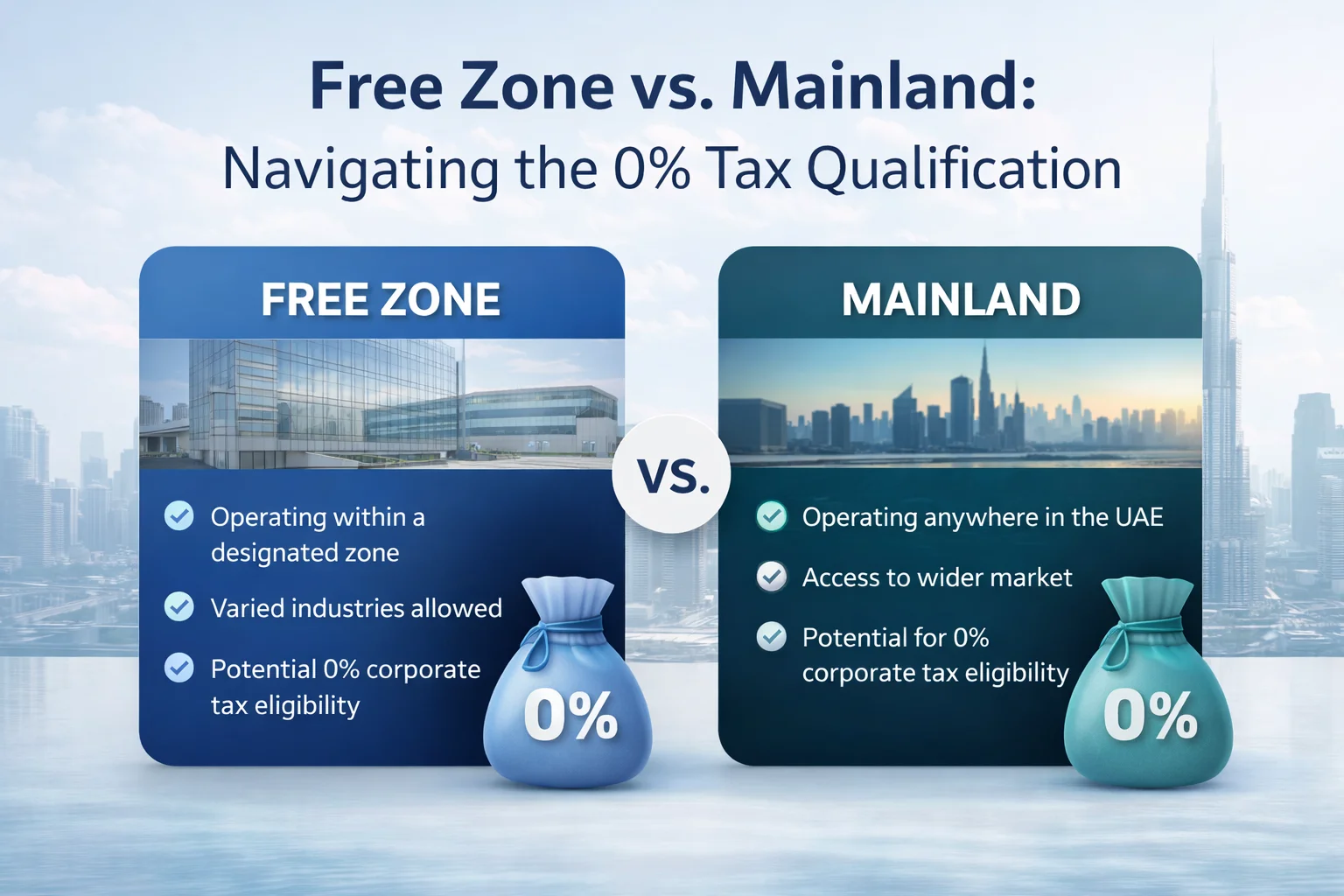
Free Zone vs. Mainland: Navigating the 0% Tax Qualification
I still remember the coffee meeting that changed how I think about UAE business structures. A founder sat across from me, frustrated, holding a penalty notice from the Federal Tax Authority. “But I’m in a free zone,” he kept repeating. “I thought I was automatically tax-free.”
He wasn’t alone in this misunderstanding. Three years into UAE’s corporate tax regime, the distinction between Free Zone vs. Mainland has evolved from a simple ownership question into a nuanced tax qualification puzzle. The 0% tax rate isn’t automatic anymore—it’s earned through compliance, substance, and strategic structuring .
Whether you’re a consultant serving international clients or an e-commerce founder scaling operations, understanding how to navigate the 0% tax qualification could save your business thousands—or expose you to unexpected liabilities. Let me walk you through what actually matters in 2026.
The Fundamental Shift: Why 2026 Changes Everythin
The UAE’s corporate tax landscape has matured significantly since its June 2023 introduction. What many business owners still don’t realize is that Free Zone vs. Mainland is no longer just about where you’re physically located—it’s about how your income is classified and whether you meet the “Qualifying Free Zone Person” (QFZP) criteria .
Under the current framework, free zone companies can access 0% tax on qualifying income, while mainland companies pay 9% on profits exceeding AED 375,000 . But here’s the catch: that 0% rate requires active qualification, not passive possession of a free zone license.
The Qualifying Free Zone Person Framework
To benefit from the 0% rate, your free zone entity must meet all of the following conditions :
- Maintain adequate substance in a free zone (employees, assets, expenditures)
- Derive qualifying income as defined by Cabinet Resolution
- Keep non-qualifying revenue below the de minimis threshold
- Prepare audited IFRS financial statements
- Comply with transfer pricing rules and documentation requirements
- Not have elected to be subject to the standard 9% regime
Fail any of these, and you’re looking at 9% tax on your entire income—plus potential penalties for the current year and next four years before you can retest your status .
Free Zone vs. Mainland: The 2026 Comparison
Let me break down the practical differences in a way that actually helps you decide:
| Feature | Free Zone Company (QFZP) | Mainland Company |
|---|---|---|
| Corporate Tax Rate | 0% on qualifying income; 9% on non-qualifying income | 9% on profits above AED 375,000 |
| Small Business Relief | Not typically applicable | Available for revenue under AED 3M (until Dec 2026) |
| Market Access | Direct international trade; mainland requires distributor/branch | Full UAE market access, government contracts |
| Ownership | 100% foreign ownership | 100% foreign ownership (most activities) |
| Substance Requirements | Strict: employees, assets, expenditures in free zone | Physical office required; visa quotas flexible |
| Compliance Complexity | High: income tracking, de minimis test, transfer pricing | Moderate: straightforward profit-based taxation |
Qualifying for 0% Tax: The Three Pillars
Through my work with clients across Dubai’s free zones, I’ve identified three non-negotiable pillars for maintaining your 0% tax status.
Pillar One: Adequate Substance
This is where most businesses stumble. The Federal Tax Authority doesn’t just want paperwork—they want physical presence. Your core income-generating activities must occur within a free zone, supported by :
- Adequate assets relevant to your business activities
- Qualified full-time employees (not just ghost employees on visas)
- Operating expenditures commensurate with your operations
One client learned this the hard way. His trading company existed almost entirely on paper—minimal staff, outsourced everything, no real operational footprint. The audit revealed insufficient substance, and he lost his QFZP status for five years.
Practical tip: If you’re outsourcing core activities, ensure you maintain adequate supervision over the outsourced work. For most activities, outsourcing must stay within the free zone. Only qualifying intellectual property activities can be outsourced more broadly .
Pillar Two: Qualifying Income
Not all income earned by a free zone company qualifies for 0% tax. The Cabinet Resolution identifies specific qualifying activities :
- Manufacturing or processing of goods
- Trading of qualifying commodities
- Holding of shares and securities for investment
- Ownership, management, and operation of ships
- Regulated fund, wealth, and investment management
- Headquarters and treasury services to related parties
- Financing and leasing of aircraft
- Logistics services
- Distribution of goods from a Designated Zone to qualifying customers
Excluded activities attract 9% tax regardless of where they’re performed :
- Transactions with natural persons (with limited exceptions)
- Banking, finance, and insurance activities
- Ownership or exploitation of immovable property (except commercial property transactions between free zone persons)
Pillar Three: The De Minimis Test
This is the safety valve—and the trap. You can earn some non-qualifying income and still maintain your 0% rate, provided it doesn’t exceed 5% of total revenue or AED 5 million, whichever is lower .
I’ve seen businesses lose their status because they casually accepted a large local contract without calculating its impact on their revenue mix. Once you exceed the threshold, the 9% rate applies to all your income, not just the excess.
Critical nuance: Certain revenues don’t count toward the de minimis calculation, including :
- Income from a domestic or foreign permanent establishment
- Income from non-commercial property in free zones
- Income from intellectual property (except qualifying IP)
When Free Zone Makes Sense (and When It Doesn’t)
You’re Probably Better in a Free Zone If:
Your clients are outside the UAE. Consultants serving international clients can structure to keep qualifying income at 0%, while mainland counterparts hit 9% once profits exceed AED 375,000 .
You’re a lean startup or solo professional. Free zones offer flexi-desks and bundled visa packages that significantly reduce overhead. You can protect seed capital while building your MVP .
You’re in e-commerce or digital services. Virtual or flexi-desk setups can be 70% cheaper than mandatory mainland office leases, and many zones now offer e-commerce licenses with payment gateway pre-approvals .
You’re an international trader. If your goods never enter the UAE onshore market, you avoid 5% customs duty entirely and can maintain 0% tax on qualifying trade income .
You Should Consider Mainland If:
Your core revenue comes from UAE government contracts. Free zone companies face restrictions bidding on government tenders directly .
You need physical retail presence. Mainland licenses allow unlimited branches and direct B2C trading across all emirates .
You’re planning rapid team expansion. Mainland offers unlimited visas tied to office size, while free zones often cap visas in entry packages .
Your business involves regulated activities. Banking, insurance, and certain financial services face restrictions in free zones .
The Domestic PE Trap: What Free Zone Companies Must Know
Here’s something that catches even experienced business owners off guard: the domestic permanent establishment concept.
If your free zone company maintains a place of business outside the free zone—even a small office in mainland Dubai—that creates a domestic PE. Income attributable to that PE is taxed at 9%, separate from your free zone entity’s qualifying income .
The good news? A domestic PE won’t disqualify your entire company from QFZP status. But it does require careful income apportionment and separate tax calculations.
Real-world example: A free zone trading company opened a small mainland showroom to display samples. The FTA attributed 30% of their revenue to that showroom, subjecting that portion to 9% tax while the remaining 70% stayed at 0%. Proper documentation saved them from losing their entire QFZP status.
Practical Steps to Maintain Your 0% Status
Based on compliance successes I’ve witnessed (and failures I’ve helped fix), here’s your action plan:
Conduct a Quarterly Income Review
Track your revenue sources religiously. Categorize each stream as qualifying or non-qualifying. Calculate your de minimis position every quarter—don’t wait until year-end to discover you’ve exceeded the threshold.
Document Your Substance
Maintain clear records of:
- Employee contracts and work locations
- Asset registers with physical location details
- Operating expenditure breakdowns
- Supervision documentation for outsourced activities
Prepare for Transfer Pricing
Even at 0%, you must maintain transfer pricing documentation for related-party transactions. The penalties for non-compliance apply regardless of your tax rate .
Get Audited IFRS Statements Early
Don’t wait until year-end. Work with your auditor throughout the year to ensure your financial statements will meet QFZP requirements. Last-minute surprises are expensive.
Consider Professional Support
The complexity of Free Zone vs. Mainland tax qualification has created a specialized niche for tax advisors. At Crossfoot, we’ve helped dozens of businesses structure their operations to maximize qualifying income while maintaining full compliance. Our Tax Accounting and Tax Planning services include QFZP health checks and substance documentation support.
The 2026 Outlook: What’s Changing
The UAE continues refining its tax framework. Recent amendments clarify the treatment of tax credits and introduce potential refund mechanisms for unutilized credits . For large multinationals, the Domestic Minimum Top-up Tax (DMTT) now applies for financial years starting after January 2025, requiring a 15% effective tax rate for groups with €750M+ global revenue .
For most small and medium businesses, however, the core QFZP framework remains stable—but enforcement is increasing. The FTA’s digital transformation, including mandatory e-invoicing, means real-time monitoring of transactions . Non-compliance penalties can reach AED 5,000 for e-invoicing violations alone .
Conclusion: Structure Smart, Stay Compliant
The Free Zone vs. Mainland decision isn’t a one-time choice—it’s an ongoing compliance commitment. The 0% tax rate remains one of the UAE’s most attractive features for international businesses, but it requires active management, not passive assumption.
That founder I mentioned at the beginning? He restructured, documented his substance properly, and now enjoys legitimate 0% tax on his qualifying income. But the penalty taught him an expensive lesson: in today’s UAE, tax benefits are earned through compliance, not granted through location.
Your move: Review your current structure against the QFZP requirements. If anything looks uncertain, get professional advice before the FTA comes asking questions.
Ready to Secure Your 0% Tax Status?
At Crossfoot, we specialize in helping businesses navigate UAE tax compliance with confidence. Whether you’re considering a Free Zone vs. Mainland structure or need help maintaining your QFZP status, our team provides:
- QFZP qualification assessments
- Substance documentation support
- Income categorization and de minimis tracking
- Transfer pricing compliance
- Audit-ready financial reporting
Contact our expert team today for a free consultation and compliance health check. Let’s ensure your business structure works for you—not against you.