

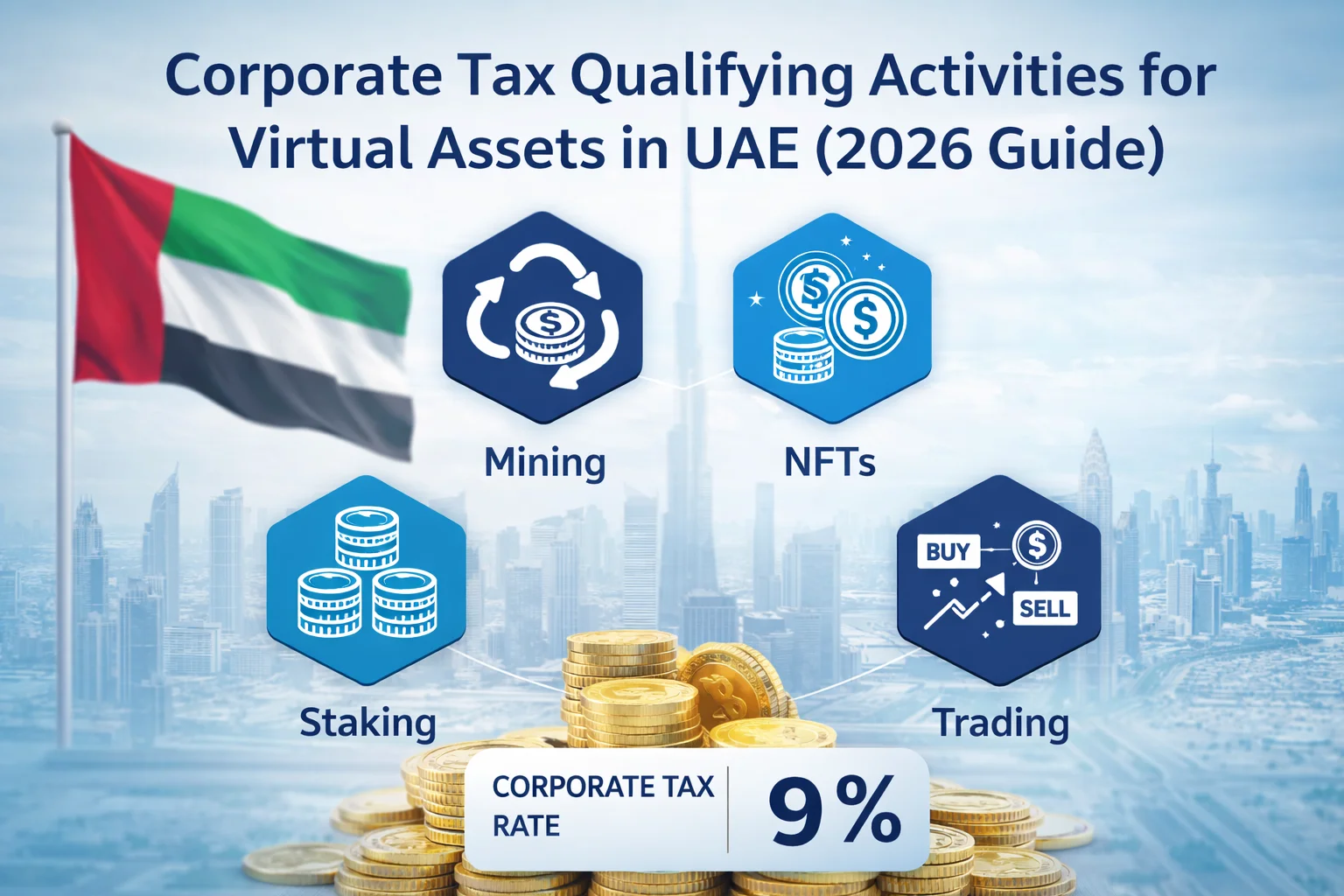
Learn corporate tax qualifying activities for virtual assets in UAE. Essential guidance for crypto businesses from expert advisors.
Table of Contents
Beyond the Hype: Understanding Corporate Tax Qualifying Activities for Virtual Assets in the UAE
The coffee had just gone cold when my client, a founder of a Dubai-based crypto exchange, asked the question that made me pause: “So, my business is regulated by VARA. Does that automatically mean my income is tax-free?”
It was February 2026, and he had just read the news about the Ministry of Finance issuing Ministerial Decision No. (336) of 2025. Like many in the region’s buzzing digital asset space, he assumed that regulatory approval equaled tax exemption. The reality, as I explained over that second cup of coffee, is far more nuanced—and far more interesting.
If you’re navigating the intersection of corporate tax qualifying activities virtual assets UAE, you’re not alone in feeling both excited and confused. The UAE has created one of the world’s most sophisticated frameworks for digital assets, but with sophistication comes complexity. Let me walk you through what this actually means for your business, separating the signal from the noise.
The February 2026 Game-Changer You Need to Understand
On February 10, 2026, the UAE Ministry of Finance made an announcement that sent ripples through the region’s crypto community. Ministerial Decision No. (336) of 2025 formally designated Dubai’s Virtual Assets Regulatory Authority (VARA) as a “competent authority” under the corporate tax framework .
This wasn’t just bureaucratic paperwork. It meant that VARA—the world’s first comprehensive virtual assets regulator—is now officially recognized among the authorities overseeing qualifying activities related to fund management services and wealth and investment management services .
But here’s what the headlines didn’t tell you:
This designation doesn’t automatically make all crypto income tax-free. Instead, it creates a framework for determining which activities qualify for the 0% corporate tax rate available to free zone businesses. Think of it less as a blanket exemption and more as a roadmap .
What “Qualifying Activities” Actually Means for Virtual Asset Businesses
Let me translate the legal language into something usable.
Under Federal Decree-Law No. 47 of 2022, a Qualifying Free Zone Person (QFZP) can enjoy 0% corporate tax on “qualifying income.” The challenge has always been: What counts as qualifying income when your business deals with assets that didn’t exist when the law was drafted?
This is where VARA’s designation becomes crucial. For corporate tax qualifying activities virtual assets UAE, the recognition means that regulated virtual asset activities—specifically fund management and wealth/investment management services—can potentially fall within the qualifying income bucket .
The Practical Breakdown
| Activity Type | Regulatory Body | Potential Tax Treatment | Key Condition |
|---|---|---|---|
| Fund Management (VA-focused) | VARA / DFSA / ADGM | 0% (qualifying) | Must meet substance requirements |
| Wealth/Investment Management | VARA | 0% (qualifying) | Regulated status + compliance |
| Exchange Trading (proprietary) | VARA | 9% (taxable) | Trading for own account |
| Custody Services | VARA | 9% (taxable service) | Fee-based revenue |
| Mining Operations | N/A (commercial) | 9% (taxable business) | Commercial mining activity |
Source: Compiled from FTA guidance and Ministerial Decision No. 336 of 2025
The distinction matters because many virtual asset businesses operate multiple revenue streams. Your exchange might charge trading fees (potentially taxable at 9%), while also managing a fund that invests in tokenized assets (potentially qualifying for 0%). These need to be separated—both in your accounting and in your mind.
The Human Story: Why This Matters for Founders
I remember sitting with a founder in DIFC last month who had built a tokenization platform for real estate assets. He was brilliant—had raised millions, assembled a world-class team—but he hadn’t thought about the tax classification of his different revenue streams.
“But we’re regulated,” he said, echoing my earlier client.
Regulation is the prerequisite, not the prize. VARA’s designation means your regulated status can now be mapped to the tax framework, but you still need to demonstrate that your activities genuinely qualify. The Federal Tax Authority (FTA) isn’t interested in marketing materials; they’re interested in substance .
What “Substance” Looks Like in Practice
- People: Do you have qualified professionals in the UAE making decisions?
- Premises: Is there a physical presence, not just a mailbox?
- Governance: Are board meetings happening, decisions documented, compliance monitored?
- Economic activity: Is the income genuinely generated from qualifying activities?
If you’re a one-person operation with a VARA license and a virtual office, expecting a 0% tax rate on all income, you’re likely in for an unpleasant surprise during an audit.
Beyond Corporate Tax: The VAT Angle You Can’t Ignore
While everyone focuses on corporate tax, VAT is where businesses often trip up. Cabinet Decision No. 100 of 2024, effective from November 2024, fundamentally changed the VAT treatment of virtual assets .
The New VAT Reality
- Transfers and conversions of virtual assets are generally exempt financial services (retroactively from January 2018!)
- Trading fees, commissions, custody charges are standard-rated at 5% when supplied in the UAE
- Mining rewards for commercial miners: taxable for corporate tax, but outside VAT scope
This creates a partial exemption headache for businesses. If you have both exempt income (asset transfers) and taxable income (fees), your input VAT recovery becomes limited. The FTA’s Public Clarification VATP040 (March 2025) provides the operational rulebook, but implementation requires robust systems .
A real-world example:
A Dubai exchange earns AED 10 million in trading fees (taxable) and facilitates AED 100 million in crypto-to-crypto trades (exempt). They pay AED 500,000 in VAT on office rent, software, and professional fees. Under partial exemption rules, they may only recover VAT proportional to their taxable income—potentially leaving a significant amount unrecoverable.
The 2026–2027 Horizon: CARF and Global Transparency
If you think the UAE is an opaque jurisdiction where crypto wealth goes unnoticed, it’s time to update your mental model.
The UAE has announced the adoption of the Crypto-Asset Reporting Framework (CARF), aligning with OECD standards .
Timeline to Watch
- 2026: Final regulations to be issued
- 1 January 2027: CARF takes effect
- 2028: First automatic exchange of crypto-related data with over 65 jurisdictions
CARF doesn’t impose tax directly—but it creates transparency. Crypto-asset service providers (exchanges, brokers, custodians) will report transaction details, account balances, and customer identification to tax authorities. That information will be automatically shared .
Translation: The era of “crypto invisibility” is ending. If you’re a UAE resident with significant crypto holdings abroad, those holdings will eventually be visible to the FTA. Planning now—not in 2028—is the difference between control and crisis.
Free Zones: Still Attractive, But Not a Free-for-All
Free zones remain a powerful draw for crypto businesses, and for good reason. The 0% corporate tax rate on qualifying income is genuinely competitive globally .
Key Free Zone Considerations for Virtual Asset Firms
| Factor | Why It Matters |
|---|---|
| Regulatory alignment | DMCC, ADGM, and DIFC all have crypto-friendly frameworks aligned with VARA/SCA |
| Substance requirements | Must demonstrate adequate people, premises, and spending in the zone |
| Qualifying income definition | Only specific activities qualify; non-qualifying income (e.g., proprietary trading) is taxed at 9% |
| Compliance burden | Free zone companies must still file corporate tax returns and maintain audited financials |
Source: FTA May 2024 Free Zone Guidance
The mistake I see repeatedly is founders assuming their free zone license is a magic shield. It’s not. If your free zone company earns income from non-qualifying activities—say, running a proprietary trading desk alongside your exchange—that portion is taxable at 9%, and the entire company could lose its qualifying status if the non-qualifying income exceeds de minimis thresholds.
Practical Steps for Virtual Asset Businesses Right Now
Map Your Activities
- List every revenue stream
- Classify each as qualifying/non-qualifying for corporate tax
- Identify VAT treatment (exempt/standard-rated)
Separate Your Books
- Maintain distinct accounting for different activities
- Track input VAT by activity type
- Document transfer pricing if using related parties
Document Substance
- Keep records of board meetings, key decisions
- Maintain employment contracts and visas for key personnel
- Track physical presence and business expenses in the UAE
Review Historical Positions
- VAT exemptions apply retroactively to 2018—consider whether prior filings need adjustment
- Corporate tax positions for 2023–2025 may need review as regulations clarify
Plan for CARF
- If you hold crypto abroad, understand what will be reported
- Consider structuring to optimize tax residency position
- Engage advisors who understand both crypto and tax
The Opportunity in Clarity
Here’s what I tell every founder I work with: Regulatory clarity is not a constraint. It’s a strategic advantage.
For years, the crypto industry operated in a grey area—exciting, but unstable. Institutions wouldn’t touch it. Serious money stayed on the sidelines. Compliance was an afterthought.
The UAE has changed that. By integrating corporate tax qualifying activities virtual assets UAE into a coherent framework—with VARA as the regulatory anchor, the FTA providing tax clarity, and CARF ensuring global alignment—the UAE has created something rare: a jurisdiction where digital asset businesses can operate with certainty.
That certainty attracts capital. It attracts talent. It attracts the institutional players who bring liquidity and legitimacy.
The businesses that will thrive in 2026 and beyond aren’t the ones looking for loopholes. They’re the ones building real operations, serving real customers, and embracing compliance as a competitive differentiator.
Your Next Move
The framework is in place. The rules are clear—clearer than in almost any other jurisdiction globally. The question isn’t whether you need to pay attention to corporate tax qualifying activities. It’s how well you’ll adapt.
At Crossfoot, we help businesses like yours navigate this new landscape. Not with generic advice, but with hands-on support that understands both the technology and the tax code. From activity mapping to VAT compliance to corporate tax structuring, we’re here to ensure your virtual asset business isn’t just compliant—it’s positioned for growth.