

5 financial models every VC demands before funding. Build better projections, valuation, and investor confidence. Expert guidance inside.
Table of Contents
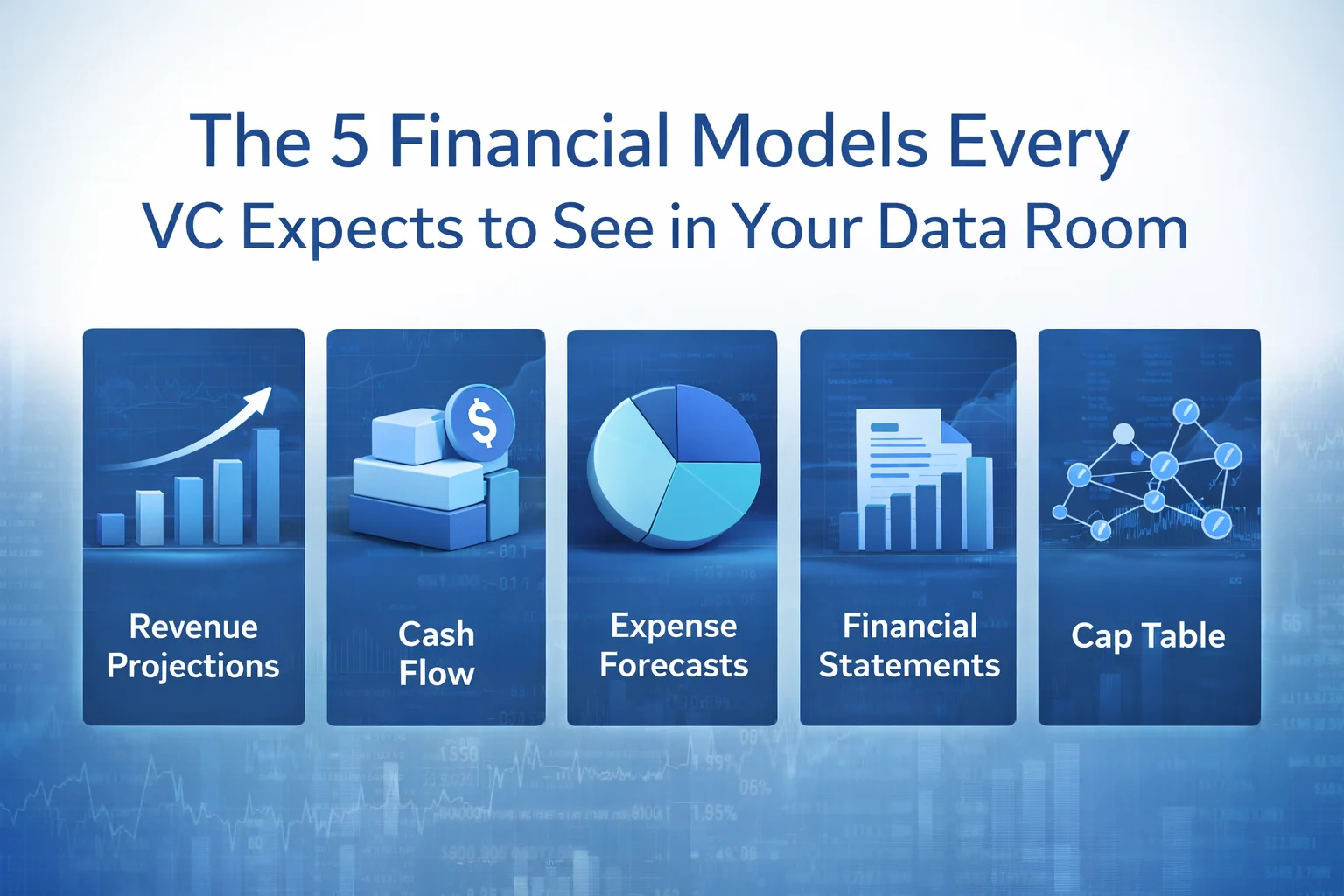
The 5 Financial Models Every VC Expects to See in Your Data Room
You’ve perfected your pitch, rehearsed your story, and lined up meetings with top-tier investors. But the moment a venture capitalist says, “Can you share your data room?”—everything becomes real. The data room isn’t just a folder of documents. It’s a reflection of your company’s maturity, your team’s diligence, and your story’s credibility.
Behind the scenes, after the handshakes and the demo, VCs dive deep into your financial models. It’s where vision meets numbers, and excitement meets scrutiny.
As someone who’s been on both sides of the table—as an operator building models and now as an advisor helping founders prepare for fundraising—I’ve seen firsthand which models make investors lean in, and which make them quietly close the tab. I’ve also heard VCs candidly say: “If the financials aren’t clear, we don’t move forward.”
In this guide, I’ll walk you through the 5 financial models every VC expects to see in your data room, why they matter, and what separates a good model from a great one.
Why Financial Models Are More Than Just Spreadsheets
To a founder, a financial model might feel like a necessary evil—something your CFO or finance team insists on. To a VC, it’s a storytelling tool, a risk assessment dashboard, and a test of operational rigor.
In fact, according to a survey by Docsend, startups with well-organized data rooms and clear financial projections raise funding up to 2 weeks faster than those with disorganized files. That’s because a clear model answers critical questions before an investor even asks them:
- How do you make money?
- How will you scale?
- Where are the risks?
- What’s your path to profitability?
Your models show whether you understand your own business—or whether you’re just guessing.
Model : The Revenue Model – Show Them the “How”
This is the starting point. Every investor wants to understand exactly how you plan to make money. And not just in a vague “SaaS model” sense—they want granularity.
What VCs Are Looking For:
- Revenue drivers: What are your key pricing levers? Customer segments? Sales channels?
- Growth assumptions: How do you plan to acquire customers, and at what cost?
- Realism: Are your projections grounded in historical data or believable benchmarks?
A SaaS company, for example, should break down monthly recurring revenue (MRR) by plan, churn rates, expansion revenue, and customer acquisition cost (CAC) payback period. A marketplace should model take rates, gross merchandise value (GMV), and buyer/seller acquisition separately.
Common Mistake: Overly aggressive “hockey stick” projections without clear driver assumptions. If you’re projecting $50M in Year 3 with no sales hires until Year 2, investors will immediately flag it.
Pro Tip: Link assumptions directly to operational metrics. If you assume a 10% conversion rate, show where that comes from—past performance, industry benchmarks (like those from ProfitWell), or A/B test results.
Model : The Operating Model – Prove You Can Execute
This is where the rubber meets the road. The operating model translates your revenue plan into a resource plan—team, marketing, infrastructure, and overhead.
What VCs Are Looking For:
- Hiring plan: Who are you hiring, when, and why?
- Burn rate: How much cash are you consuming each month?
- Unit economics: Is each customer profitable? (Hint: They should be.)
Here’s a simple but effective way to structure this:
| Department | Headcount (Y1) | Key Hires | % of Revenue |
|---|---|---|---|
| Sales & Marketing | 5 | CRO, 2x AE, Content Marketer | 30% |
| Product & Engineering | 8 | CTO, Full-Stack Devs, DevOps | 25% |
| G&A | 3 | CFO, HR, Operations | 15% |
Common Mistake: Underestimating non-salary costs (benefits, tools, office space, taxes). These typically add 15–20% on top of salaries.
Pro Tip: Use your operating model to showcase strategic prioritization. Are you hiring engineers before marketers because product readiness is key? Explain that narrative.
Model : The Cap Table & Ownership Model – Clarity on Equity
This is non-negotiable. A messy cap table is one of the fastest ways to scare off investors. They need to know who owns what, what options are set aside, and what future dilution looks like.
What VCs Are Looking For:
- Clean ownership structure: Founders, employees, previous investors.
- Employee option pool: Size, vesting terms, and remaining unallocated options.
- Future dilution scenarios: How will this round affect ownership?
Pro Tip: Use a tool like Carta or Pulley to keep this clean and investor-ready. Include a post-money cap table simulation showing ownership after the current round.
If you have any unusual terms—like founder vesting, debt conversions, or special rights—explain them clearly in a summary note. Transparency builds trust.
Model : The Cash Flow Model – Survival & Runway
Revenue is vanity, profit is sanity, but cash is king. You can be growing 200% year-over-year and still run out of money. The cash flow model shows whether your business can survive its own growth.
What VCs Are Looking For:
- Monthly cash burn: How quickly are you spending money?
- Runway: How many months do you have until you need more cash?
- Key cash drivers: Where are the biggest outflows? (Payroll, marketing, R&D?)
Founders often confuse P&L profitability with cash flow. You might be “profitable” on paper but still have negative cash flow due to upfront customer acquisition costs or inventory purchases.
Pro Tip: Include a “Worst-Case Scenario” tab. Show what happens if growth is 50% slower or CAC doubles. It shows you’ve thought about risks—and it prepares investors for tough questions.
Model : The Valuation & Returns Model – The Investor’s Lens
Finally, VCs want to see that you understand their business—which is generating returns. A returns model helps them visualize the potential outcome of their investment.
What VCs Are Looking For:
- Exit scenarios: Who could acquire you? What’s a realistic IPO timeline?
- Multiple on invested capital (MOIC): What could their return be?
- Sensitivity analysis: How do returns change if growth is faster/slower?
For example:
| Exit Year | Revenue | Exit Multiple | Exit Valuation | Investor Return (5x?) |
|---|---|---|---|---|
| 2028 | $150M | 10x | $1.5B | 30x MOIC |
| 2030 | $300M | 8x | $2.4B | 50x MOIC |
Common Mistake: Overly optimistic exit multiples. Use data from PitchBook or CB Insights to benchmark realistic acquisition multiples in your sector.
Pro Tip: Frame this as a partnership. Show how their capital accelerates growth and improves outcomes for everyone—not just a dry financial exercise.
How to Present These Models: Beyond Excel Sheets
Having the models is one thing. Presenting them clearly is another.
- Include an executive summary tab in each model explaining key assumptions.
- Use charts and graphs to visualize growth, burn, and runway.
- Clean formatting matters: No broken links, clear labeling, consistent formulas.
- Protect sensitive cells but leave assumptions editable—VCs will stress-test them.
Also, consider what Andreessen Horowitz highlights in their startup guide: “The best models are simple, transparent, and tell a compelling story.” Don’t try to impress with complexity. Impress with clarity.
What If You’re Pre-Revenue or Pre-Seed?
Even if you don’t have historical data, you still need these models—but focus on assumptions rather than outputs.
- Base assumptions on industry research, analogs, and early pilot data.
- Show that you understand your key metrics and what drives them.
- Be honest about what you don’t know, and outline how you’ll de-risk those assumptions.
The One Thing VCs Secretly Judge
Beyond the numbers, VCs are judging your operational discipline. A well-organized data room with clear, logical financial models signals that you’re detail-oriented, transparent, and prepared to scale.
As a partner at a leading venture firm once told me: “I don’t need the model to be perfect. I need to see that the founder has thought through the variables. That tells me they can navigate uncertainty.”
Ready to Build Investor-Ready Financial Models?
You don’t have to do this alone. At Crossfoot, we help founders build clear, credible, and compelling financial models that tell their story with numbers. From cap table simulations to cash flow forecasting, we ensure your data room not only meets VC expectations—but exceeds them.
Need a review of your financial models before you hit “send” on your data room?
Book a free strategy session with our fundraising advisory team
Have questions about financial modeling or VC readiness? Drop them in the comments—we’d love to help.