

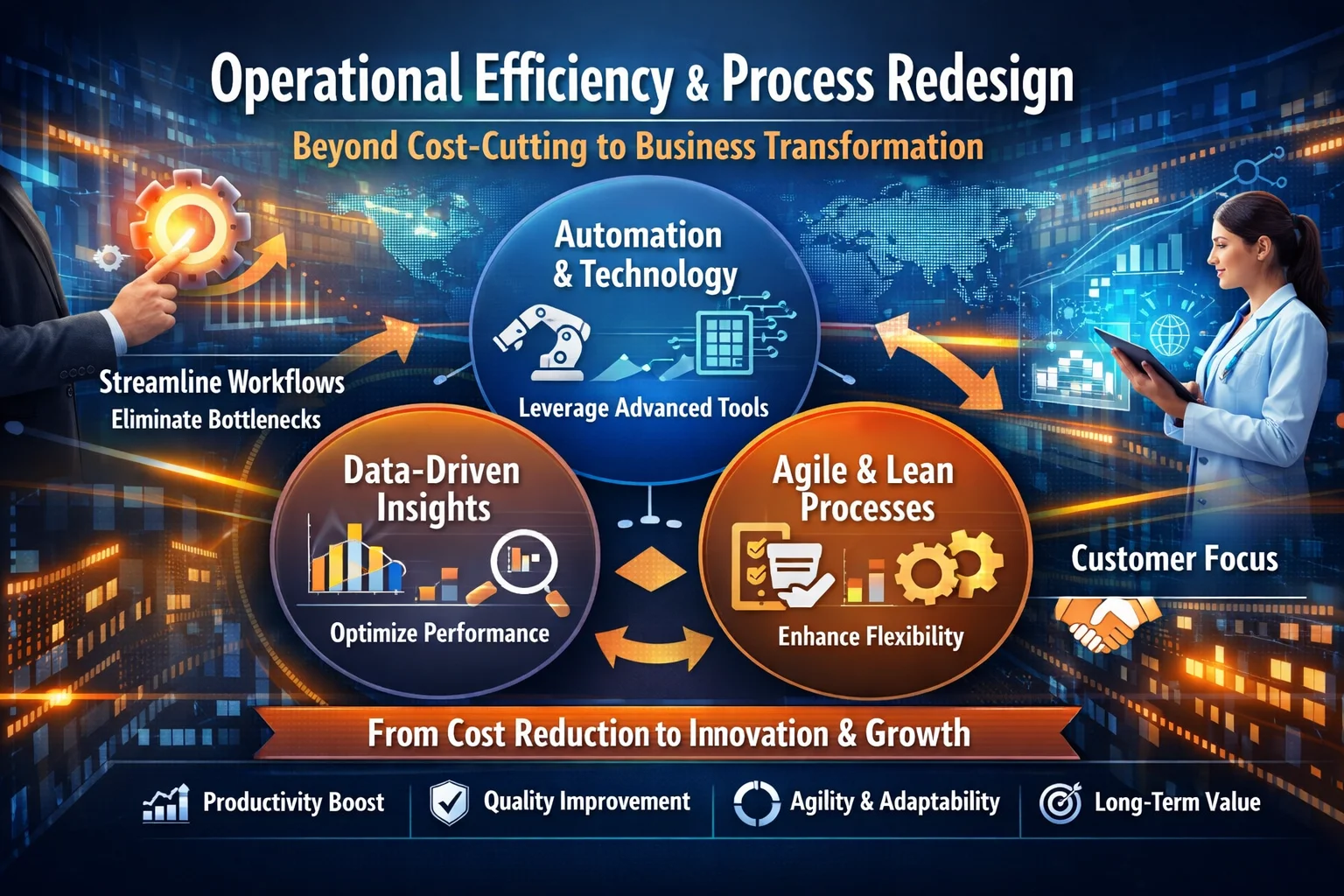
Streamline workflows cut costs and scale smarter. Expert operational efficiency & process redesign for UAE businesses ready to grow.
Table of Contents
How Operational Efficiency & Process Redesign Can Transform Your Business from Within
The Coffee Cup That Changed Everything
It was 7:45 AM on a Tuesday when Sarah, our operations manager, dropped her coffee. Not just any spill—this was the third time that month she’d stumbled over the same misplaced supply cart. As she wiped espresso off her reports, something clicked. “Why is this cart here? Who decided this? And how many hours are we losing to avoidable collisions?”
That moment of sticky frustration became our company’s turning point. It wasn’t about the cart. It was about asking the dangerous, beautiful question: “Why do we do things this way?”
This is where real operational efficiency & process redesign begins—not with spreadsheets or consultants, but with human moments that reveal how our daily work rituals either serve us or sabotage us.
More Than Metrics: The Heart of Operational Efficiency
When most businesses hear “operational efficiency,” they think cost-cutting. Layoffs. Doing more with less. But what if we’ve been missing the point?
True operational efficiency isn’t about scarcity—it’s about abundance. It’s about creating space. Space for innovation. For quality. For employee satisfaction. For serving customers better.
Consider this: Companies with optimized operations report 40% higher employee engagement according to Gallup research. Why? Because people don’t enjoy waste. They don’t enjoy frustration. They want their work to matter, and efficient processes make work meaningful.
Process Redesign: The Art of Asking “What If?”
Process redesign often gets treated like corporate surgery—painful, expensive, and best done while the patient is unconscious. But what if we approached it more like gardening?
You don’t rip out every plant. You observe. You notice what’s thriving and what’s struggling. You improve the soil. You redirect resources.
The Three Levels of Process Maturity
Most organizations operate at one of these levels:
| Level | Mindset | Symptoms | Human Impact |
|---|---|---|---|
| Chaotic | “This is just how we do things” | Constant firefighting, high stress, inconsistent results | Burnout, high turnover, apathy |
| Managed | “We have documented procedures” | Moderate efficiency but resistant to change, “that’s not my job” culture | Complacency, siloed thinking |
| Optimized | “How can we make this better?” | Continuous improvement, employee-driven innovation, adaptability | Engagement, ownership, growth mindset |
Most companies get stuck between Chaotic and Managed. The leap to Optimized requires deliberate process redesign.
The Hidden Costs of “How We’ve Always Done It”
Let me share a personal story. Early in my career, I worked with a manufacturing client proud of their “proven” 15-step approval process for raw material purchases. It had been in place since 1987.
When we mapped it out, we discovered:
- 12 of the 15 signatures were “rubber stamp” approvals
- The process took 17 days on average
- 8 different departments touched each request
- The actual decision was made at step 3
The cost? Not just in time. In human terms:
- Purchasing managers felt powerless
- Department heads resented “administrative work”
- Production delays created constant inter-departmental tension
When we redesigned this to a 4-step value-added process, magic happened. Time reduced by 76%. But more importantly, people started talking differently. They said “we” instead of “they.” They collaborated instead of blaming.
The Psychology of Change: Why Process Redesign Fails (And How to Succeed)
Harvard Business Review reports that 70% of change initiatives fail. Not because of bad ideas, but because of bad human implementation.
Common Pitfalls:
- The Dictatorship Approach – Leadership designs in isolation, then “rolls out” to employees
- Analysis Paralysis – Endless mapping without action
- The Silver Bullet Fallacy – Believing technology alone will solve process problems
- Missing the Why – Focusing on “what” changes without explaining “why”
What Works:
Start with the pain. Not corporate pain—human pain. What frustrates your team daily? What small irritant, like Sarah’s supply cart, represents a larger systemic issue?
Include the experts—and the experts are the people doing the work. The accounts payable clerk knows the vendor process better than any consultant. The customer service representative understands the complaint flow intimately.
Celebrate quick wins. Process redesign doesn’t need to be a massive overhaul. Sometimes moving that supply cart saves 15 minutes daily. That’s 65 hours annually. That matters.
Practical Framework: The CARE Method for Process Redesign
After years of trial and error, we’ve developed a human-centered approach:
Current State Mapping (With Empathy)
Don’t just document steps. Document emotions, frustrations, and hidden workarounds. How many sticky notes are on someone’s monitor? Those are process failures.
Analyze for Value
For each step, ask:
- Does this create value for our customer?
- Does this create value for our employee?
- If no to both, why does it exist?
Redesign Collaboratively
Gather the actual process users. Use simple tools—whiteboards, sticky notes, honest conversation. The best ideas often come from the quietest person in the room.
Execute with Support
Change is scary. Provide training, support, and permission to fail. Measure not just efficiency gains but human metrics: stress levels, satisfaction, engagement.
Technology as Enabler, Not Savior
Here’s the truth: No software will fix broken processes. It will only make broken processes faster.
Before implementing any new system:
- Fix the human process first
- Then find technology that supports the improved process
- Never let technology dictate your human interactions
Microsoft’s research on digital transformation shows that organizations focusing on people and processes first are 3.5 times more likely to succeed than those focusing on technology alone.
The Ripple Effect: Beyond the Balance Sheet
When we helped a retail client redesign their inventory process, we expected the financial benefits. We got them: 30% reduction in carrying costs, 25% improvement in stock turnover.
But the unexpected benefits mattered more:
- Store managers reported 50% less stress
- Employee turnover in inventory roles dropped by 40%
- Customer satisfaction scores increased (because items were actually in stock)
- Team members started suggesting improvements to other processes
That’s the real power of operational efficiency & process redesign—it creates a culture of continuous improvement. It tells employees: “Your experience matters. Your ideas matter.”
Getting Started: Your First Step Doesn’t Need to Be Big
You don’t need a consulting firm or a massive budget. Start here:
This week: Identify one small frustration. One “coffee spill” moment in your organization.
This month: Gather the people involved. Map the current process together. Not in a conference room with PowerPoint—on a whiteboard. With honesty.
This quarter: Implement one improvement. Measure both the operational and human impact.
Remember Sarah’s supply cart? Moving it took 15 minutes. The conversation it sparked saved hundreds of hours. The cultural shift it started? Priceless.
The Ultimate Efficiency: Human Potential
At its best, operational efficiency & process redesign isn’t about eliminating waste. It’s about eliminating barriers. Barriers to creativity. To satisfaction. To doing our best work.
The most efficient process in the world is one where engaged, empowered people solve problems before they become crises. Where employees spend their energy creating value rather than navigating bureaucracy.
That supply cart wasn’t just in the wrong place. It was a symbol of unasked questions. Of accepted frustration. Of potential waiting to be unlocked.
Ready to Transform Your Operations—and Your Culture?
At Crossfoot, we believe numbers tell only half the story. The human impact—the reduced stress, the renewed engagement, the rediscovered purpose—that’s the transformation that truly matters.
What’s your “supply cart”? What small frustration in your organization might reveal a larger opportunity?
Let’s have that conversation. Not as consultants and clients, but as fellow travelers on the continuous improvement journey.
Explore our approach to human-centered operational efficiency, or reach out for a conversation about where your organization is—and where it could be.
Because sometimes, all it takes is looking at an ordinary Tuesday morning with fresh eyes. And maybe moving a cart.